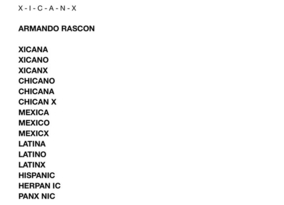
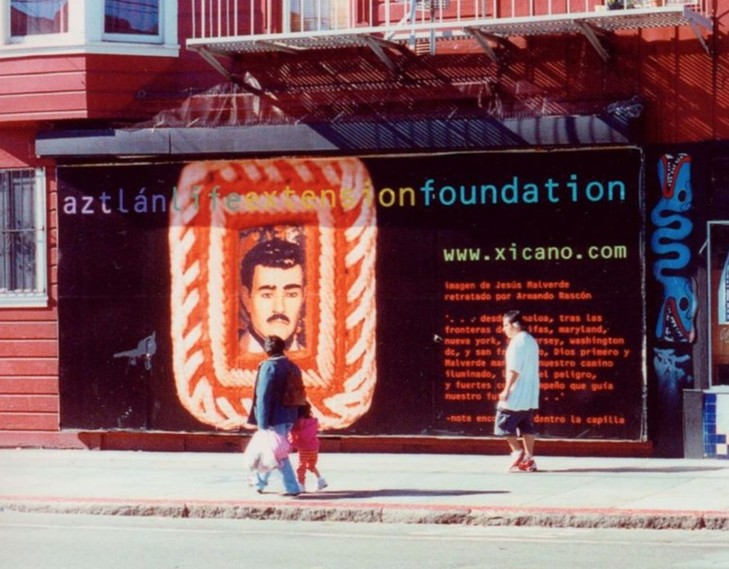
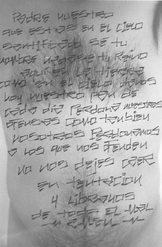
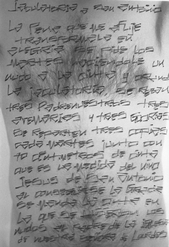
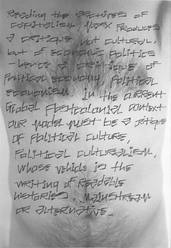
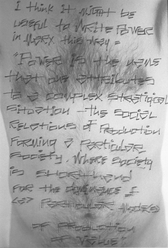
Aztlán Life Extension Foundation, by Armando Rascón, 2001. Digital Mural on exterior face of Galería de la Raza, Mission District, San Francisco. Foundation information was posted on xicano.com, Rascón's domain for electronic content distribution and presentation. The site went live in 1996 and was re-encoded to xicanx.net in 2016 to signal solidarity with Latinx, feminist, queer and non-binary online communities of cultural warriors and stalwarts.
|
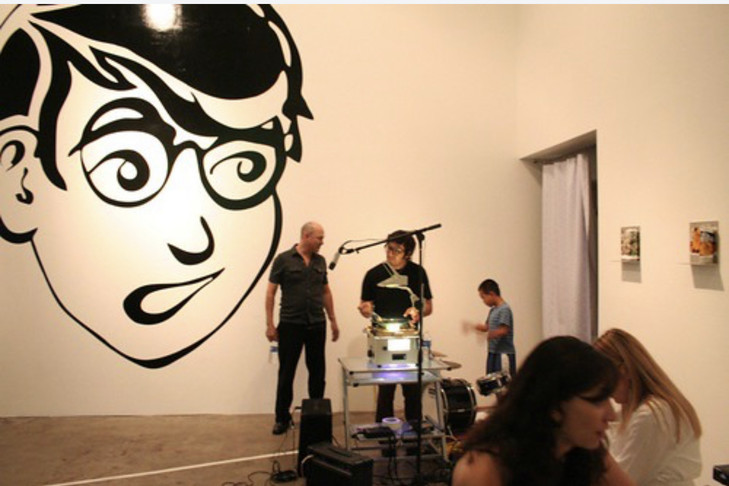
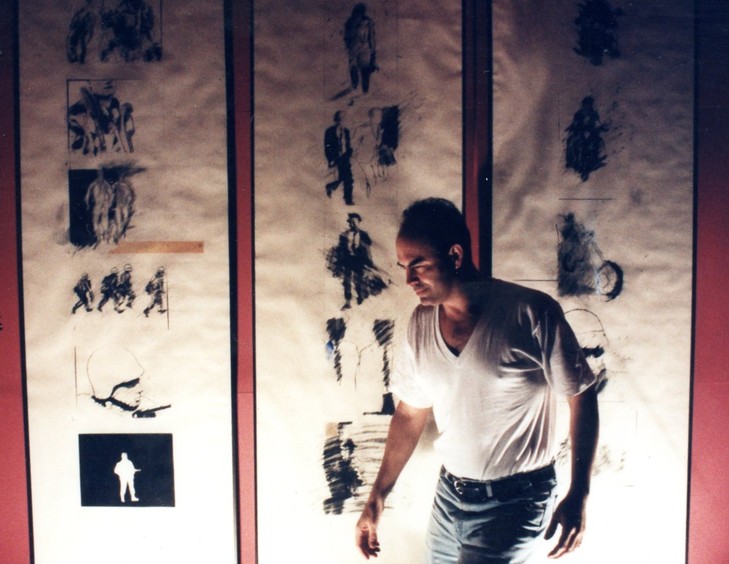
Border Boy, by Armando Rascón. Vinyl mural, 2008. The shot is a view of BEZANDO collective members Armando Rascón and Juan Quintero in performance at Art for Humans Gallery, Chinatown, Los Angeles. The Border Boy piece was removed after the exhibition closed.
|
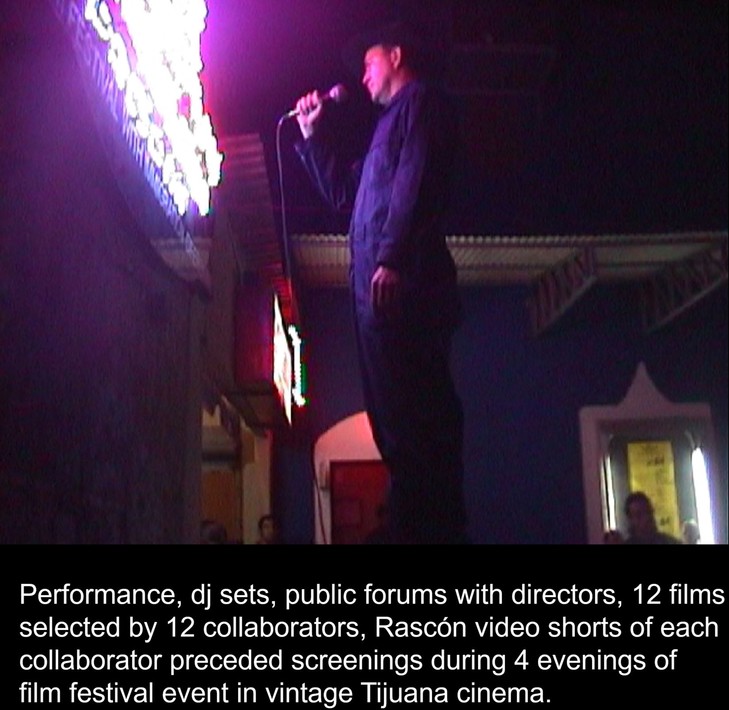
Cine Futuraztlán Presenta: Film Festival with Immigration Differential, 1999-2000 project by Armando Rascón --a solo artist commission for INSITE 2000, an international site-specific festival held in San Diego and Tijuana, Baja California, Mexico. The project marque installed at the Cinelandia2000 movie house venue in downtown Tijuana for Rascón's site-specific ‘engagement in the public sphere’ and multi-procedurally complex project was a white neon language piece created as one of “99 actions for film festival” by Rascón —a secondary purpose was to light up the dark nocturnal plaza adjacent to the movie-house entrance. The piece remained as a memento to the immigration-specific film festival for about a year before it was vandalized by unknown locals. The neon marque piece was removed at that point, circa 2001.
The final night of the project the digital camera and all documentation digital tapes were stolen from the Cinelandia projection room upstairs, the ensuing effort to recover actual footage of the "99 actions for film festival" was futile and determined never to be recovered. Rascón will post a clip of the 99 actions that were performed based on the advance material written for inSITE 2000 that resides in his artist archive.
Rascón worked with Cuban curator Osvaldo Sanchez Crespo to develop this project.
|
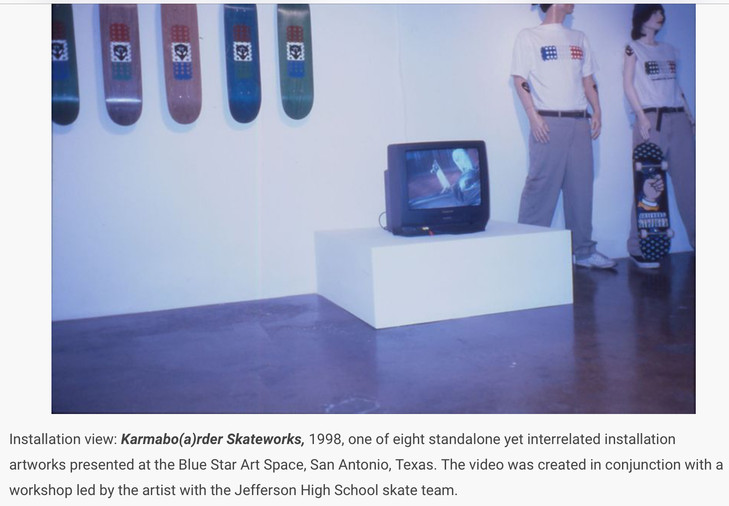
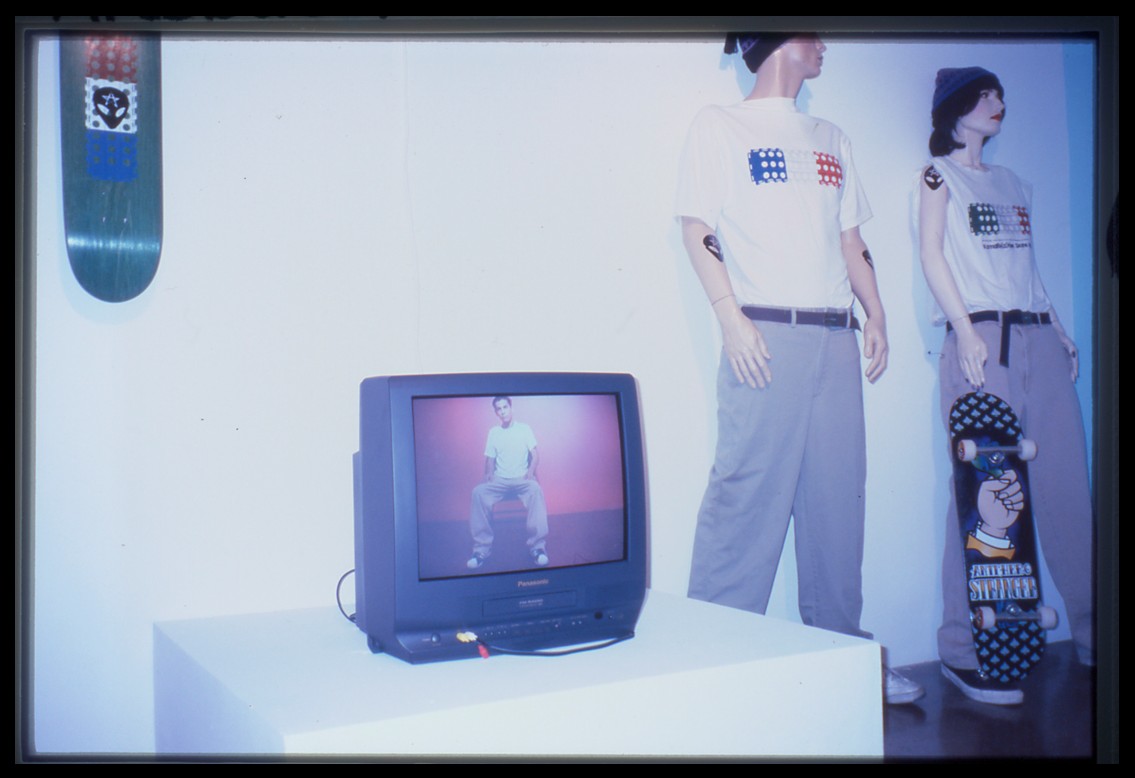
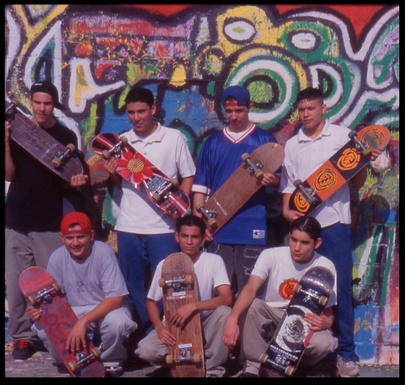
Karmabo(a)rder Skateworks project was expanded by Rascón by including a two-day residency with Xicanx members of the Jefferson High School skate team. The athletes worked alongside Rascón in the setup of the installation as well as in the production of the athlete involved video. Site specific work is active as long as the site is in context as in “in-situ”, and it may be governed by these factors —or not. The artist sets the terms. The descendants do not necessarily enforce these terms. The piece may yet be reinscribed as a legacy work in good time. The video is being transcoded from VHS to digital at the present time.
|
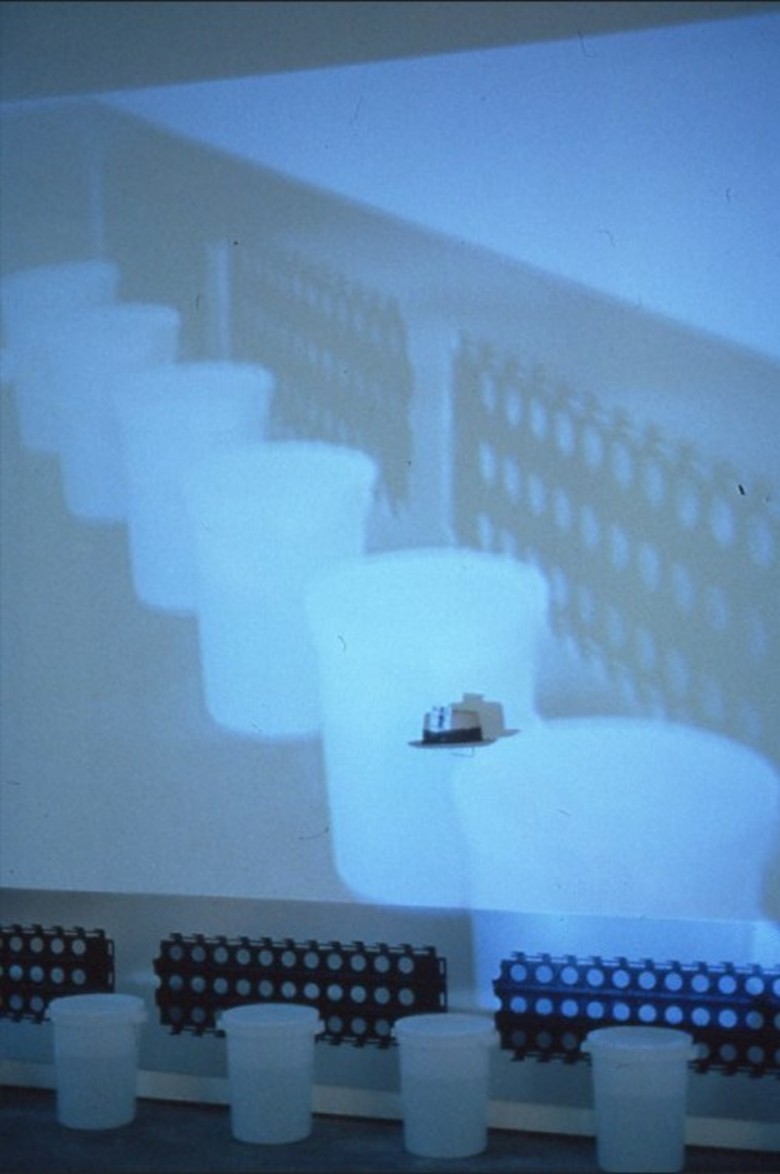
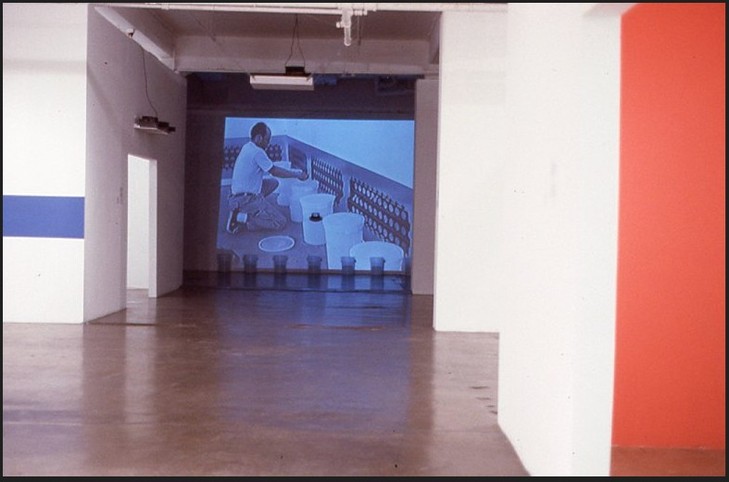
Santa Fe (Light Spirit Dream), 1997, video, RT: 25 minutes.
The work opens with Rascon's ritual action of creating thirty gallons of holy water from a small vitamin container with holy water given to the artist by his grandmother. The 30 gallons of water were ported from the San Antonio River to the gallery by Rascon and gallery staff. The San Antonio River water is in the seven white plastic containers on the floor by the projection screen wall. Installation view, Blue Star Art Space, San Antonio(below) 1998.
Rascón quote:
One of my grandmother’s many nieces or nephews returned from a visit to the Vatican with a sample of holy water f rom the St. Peter Baslica. My Nana proceeded to make multiple smallish containers of holy water from the embryonic one from Italy, then filling a number of tiny plastic containers to hand out to her extensive family. This is how I learned how to make holy water. At the close of the project at San Antonio’s Blue Star Art Space, the water was released back to its source.
|
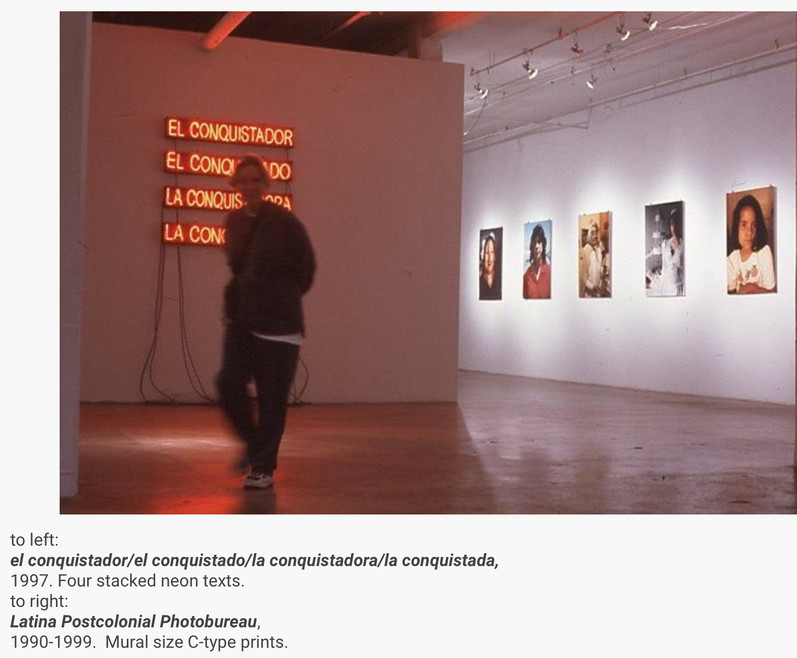
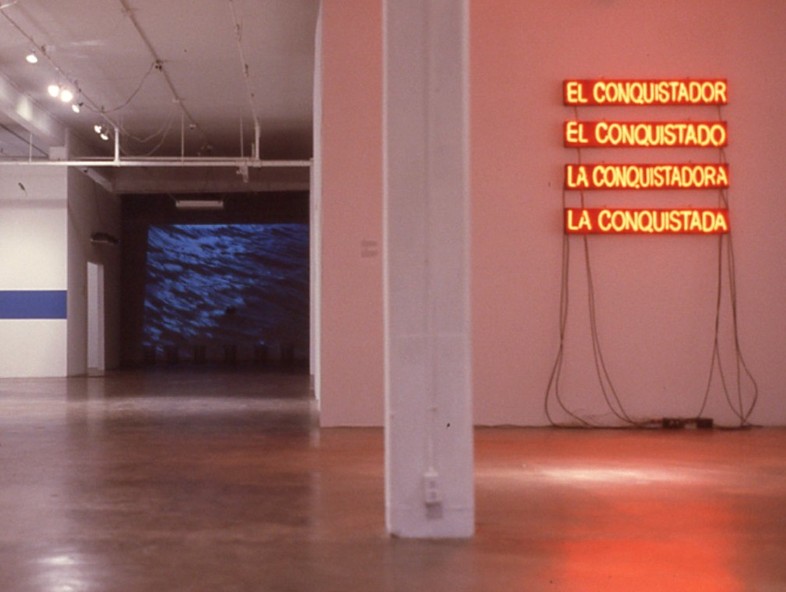
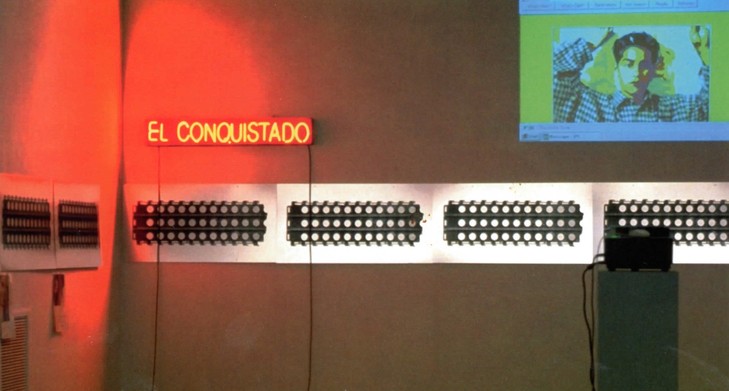
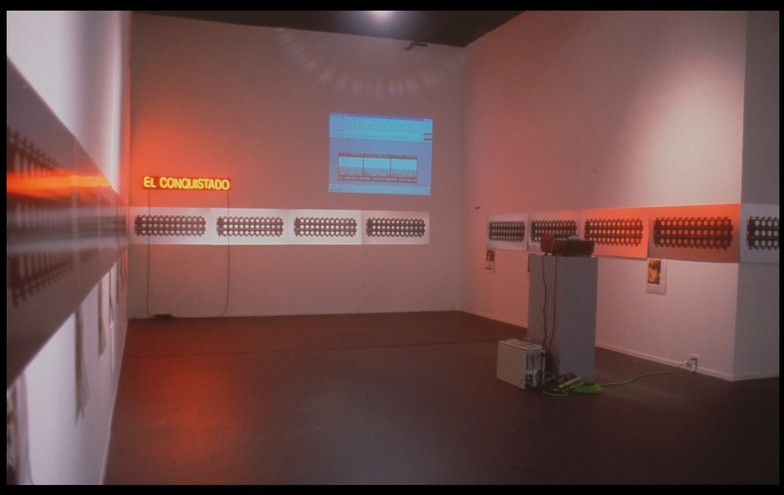
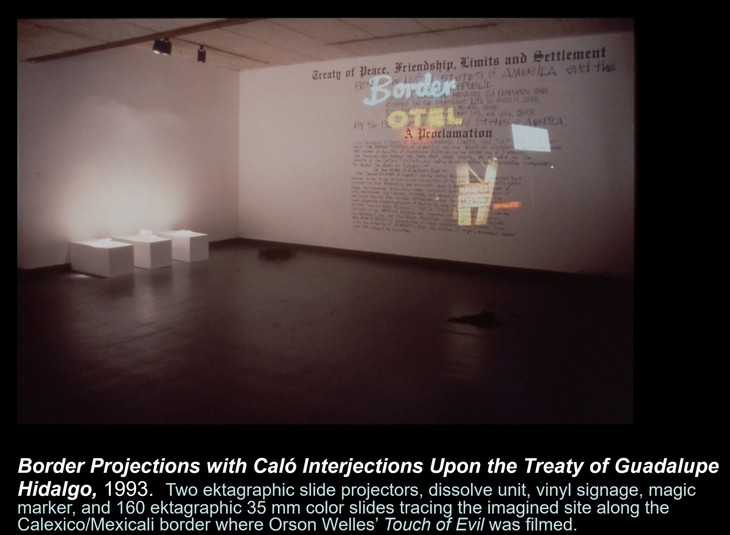
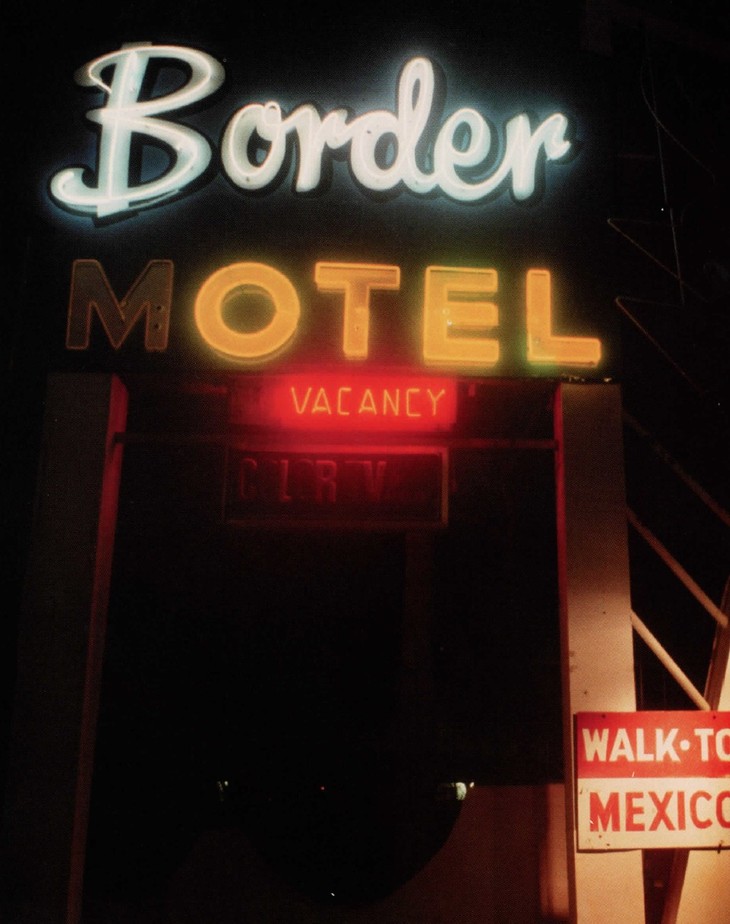
The four panel neon was produced in Tijuana, Baja California for the exhition “Armando Rascon: Postcolonial Califas” that was a joint production between the Museum of Contemporary Art, San Diego and the Centro Cultural de la Raza in 1997. The project was co-curated by Patricio Chavez and Louis Grachos.
In typical conceptual Fluxus fashion, for Rascón all moving parts of any exhibitions are free to conjoin other exhibition projects to redefine themselves contextually. This became the case with the “Conquistador / Conquistador / Conquistadora / Conquistada” neon as seen above at the Blue Star Art Space in San Antonio, Texas.
The piece was damaged by the return shipper and may yet be recovered.
|
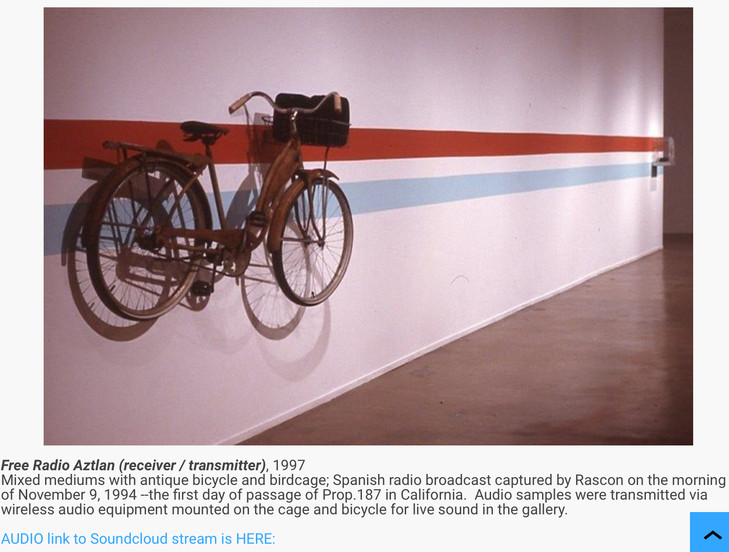
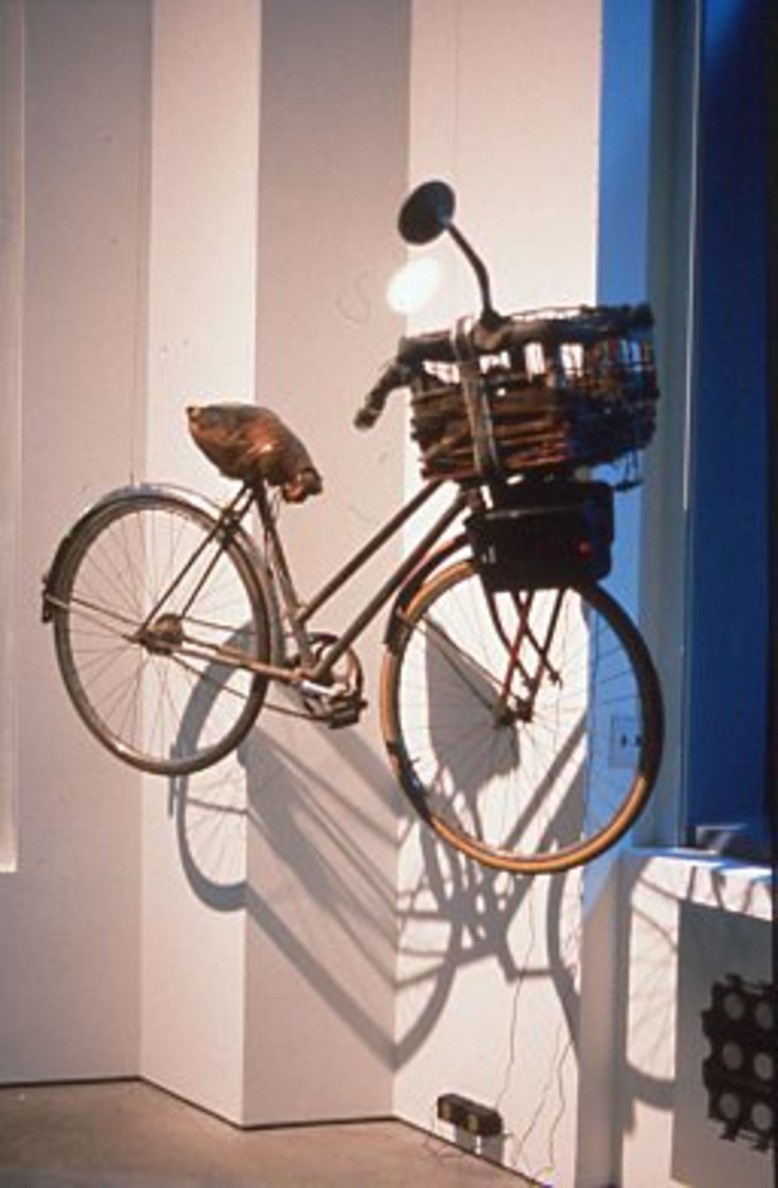
LINK to Soundcloud Audio. On the day California passed Proposition 187 on November 9, 1994 live radio hosts began a “Immigrant Best Practices” campaign on local Spanish radio in Northern California. This is the audio feed that was placed on an endless loop inside the gallery space. The bicycle held the speakers, the birdcage held the wireless transmitter. A playlist with pop music repeated between intermittent radio host warnings to parents about the safety of their children at public schools due to Immigration Naturalization Service proposed actions. This piece was realized in 1994. Thirty years later all of the knowledge that was harvested from early anti-immigrant warnings have continued to weaken to the demands of a racially polarized electorate. Xicanx sovereignty is key to remaining resolute to the destruction of our people in coming months and years.
|
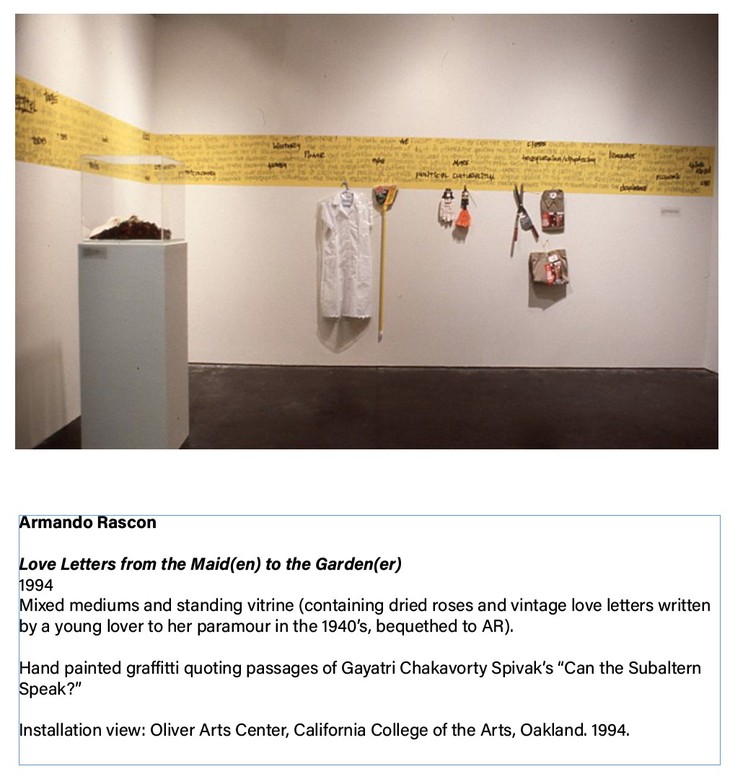
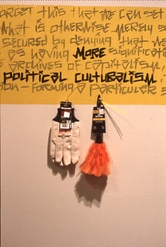
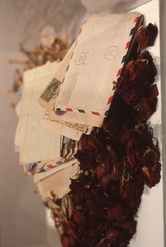
Love Letters from the Maid(en) to the Garden(er), 1994,
This ephemeral installation at the California College of Arts and Crafts was dismantled
by Rascón after close of the exhibition and the walls painted over. The documentary
photograph above is the only remaining proof of the work.
|
Photo Album Gallery Place Holder - Please wait while the Photo Album loads.
If the album does not show, please refresh the page to try again.
|
Armando Rascon: Postcolonial Califas, a dual-institution solo exhibition comprising both the Museum of Contemporary Art, San Diego and Centro Cultural de la Raza, San Diego. The project was curated by Louis Grachos (MCASD) and Patricio Chavez (Centro).
|
Installation view: web art projection Institute for Xicano Relations: Postcolonial Califas at the Centro Cultural de la Raza, San Diego. The web projection was being broadcast in the Centro and elsewhere as https://www.XICANO.COM concurrently with the project Armando Rascón: Postcolonial Califas concurrently at the Museum of Contemporary Art San Diego and Centro Cultural de la Raza, 1997.
|
Installation view: web art projection Institute for Xicano Relations: Postcolonial Califas at the Centro Cultural de la Raza, San Diego. The web projection was being broadcast in the Centro and elsewhere as https://www.XICANO.COM concurrently with the project Armando Rascón: Postcolonial Califas concurrently at the Museum of Contemporary Art San Diego and Centro Cultural de la Raza, 1997.
|
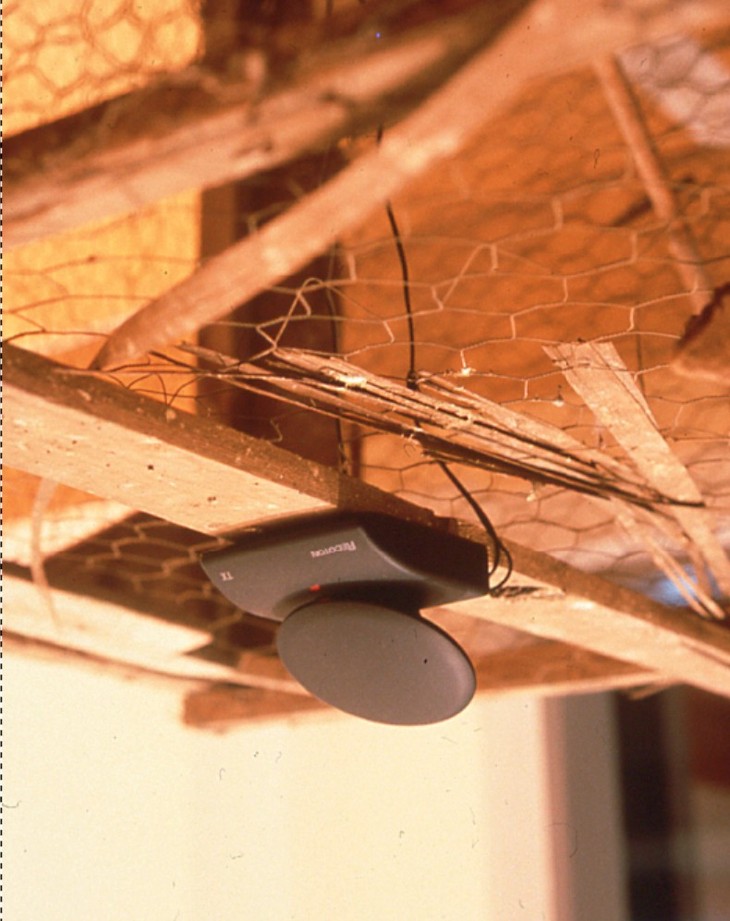
Free Radio Aztlán (Receiver), 1997
Installation view at Museum of Contemporary Art, San Diego.
Armando Rascón: Postcolonial Califas
Media installation in three parts:
Bicycle fitted with wireless speakers.
Chicken coop fitted with transmitter.
360 hour-long music playlist, with intermittent radio broadcast from Northern California Spanish speaking radio public service announcements intended for Latinx undocumented populations in light of passage of Proposition 187 in the state of California.
|
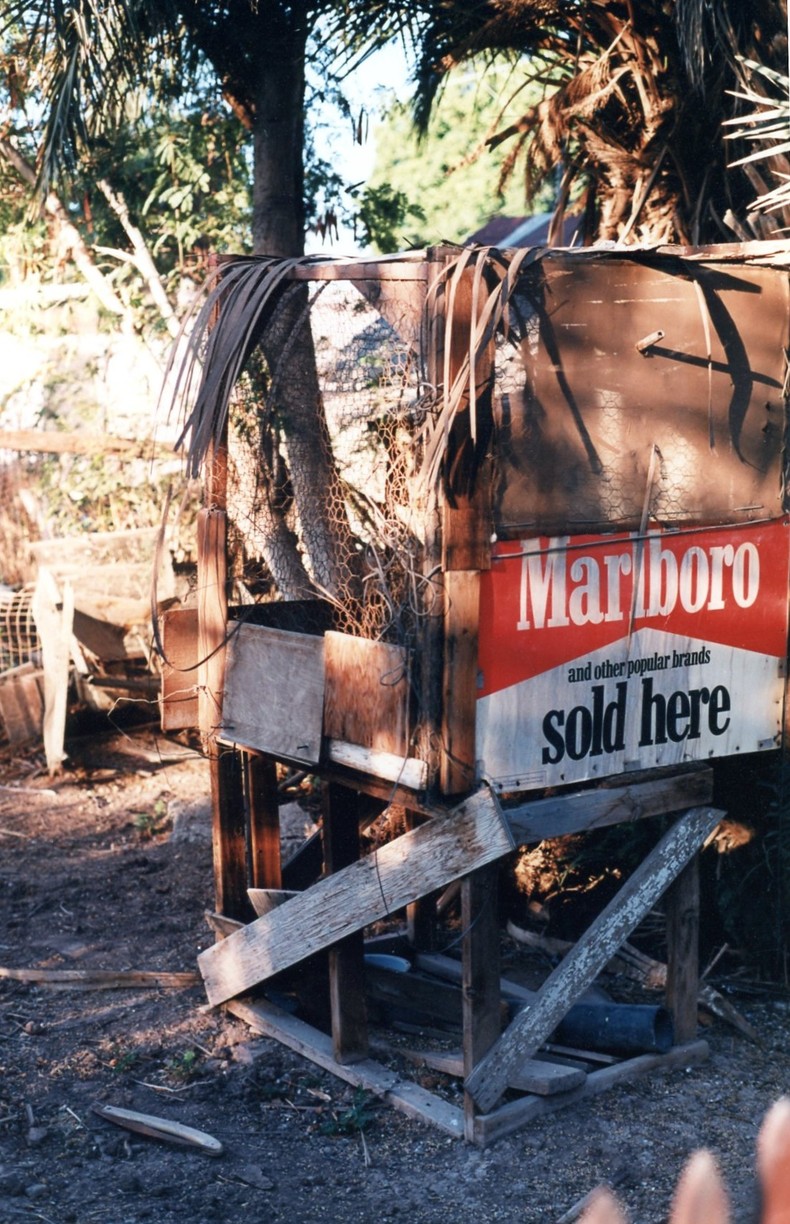
Free Radio Aztlán (Origin Story: Calexico backyard construction), 1997Photograph by Armando Rascón © 1994-2026. Image capture of object in-situ prior to relocation to MCASD, San Diego, California. My cousin had built the structure in grandmother's back yard (with minor help from me) when we were ten years old. This shot does not give a clue as to the wild, lush, verdant gardens that had once proclaimed Nana's back yard, but had ceased to exist upon her passing four years earlier in 1990.
|
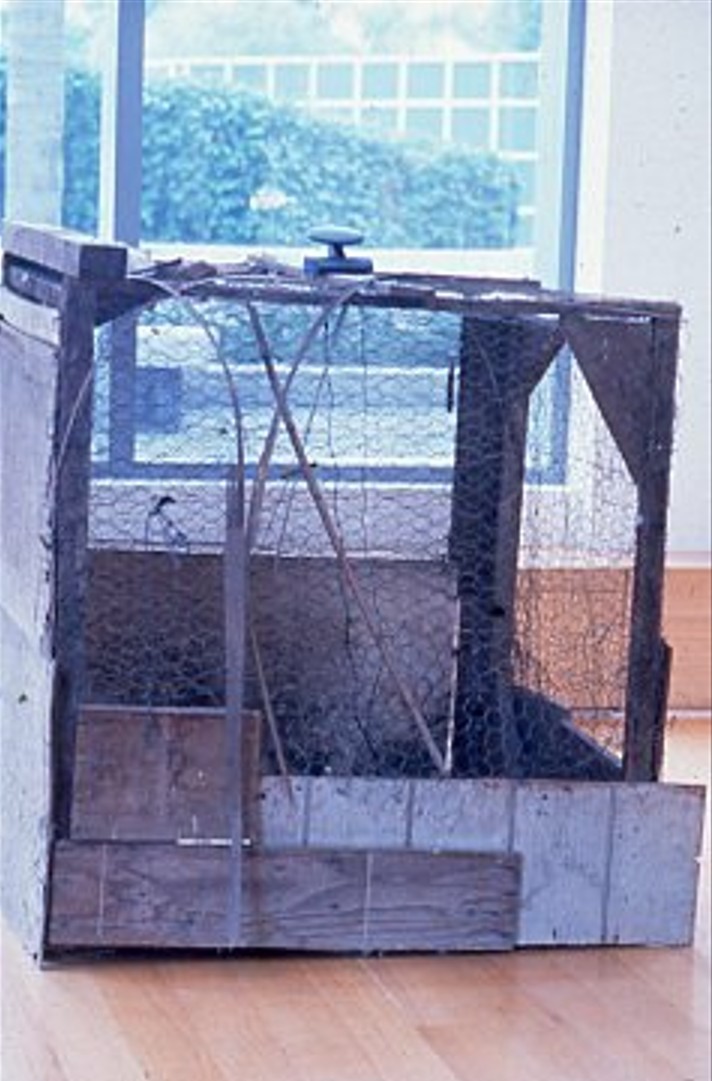
Free Radio Aztlán (Transmitter), 1997
Installation view at Museum of Contemporary Art, San Diego.
Armando Rascón: Postcolonial Califas
Large chicken coop holds wireless transmitter.
Bicycle holds wireless speakers (See top image with bicycle): Rascón prepared a 360-hour playlist presenting a range of music --from banda,
hip hop, to techno blasters, to piano bar melodic, to country, to classical-- to simulate a
radio station on an endless loop, interrupted randomly with the recorded broadcast from November 9, 1994 the day Proposition 187 went into effect in the state of California, with
radio hosts attempting to communicate to the very large immigrant populations of Northern California.
|
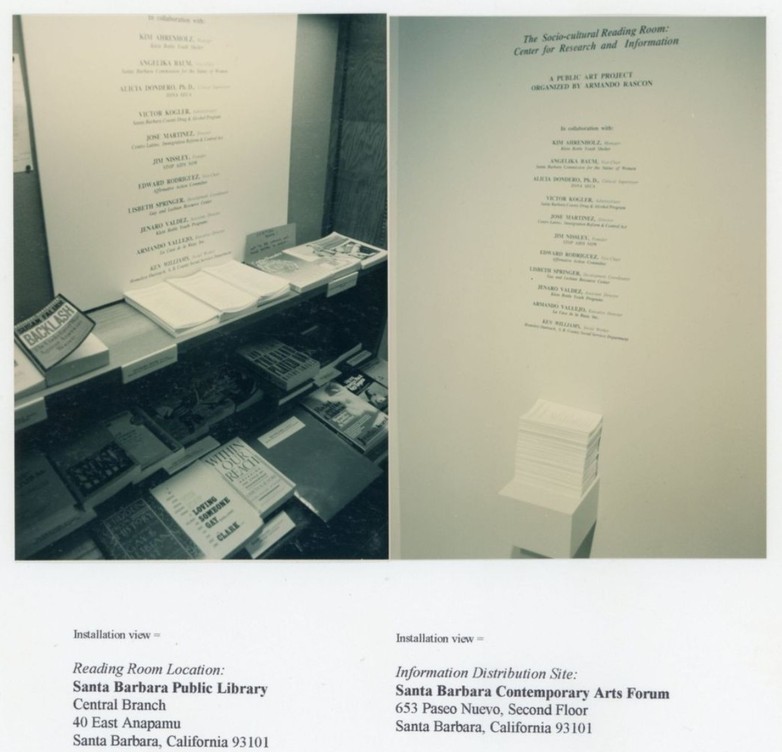
Armando Rascon:
Socio-cultural Reading Room: Center for Research and Information, 1992
Contemporary Arts Forum, Santa Barbara, California
Santa Barbara Main City Library.
Exhibition pamphlet is HERE
|
Armando Rascón:
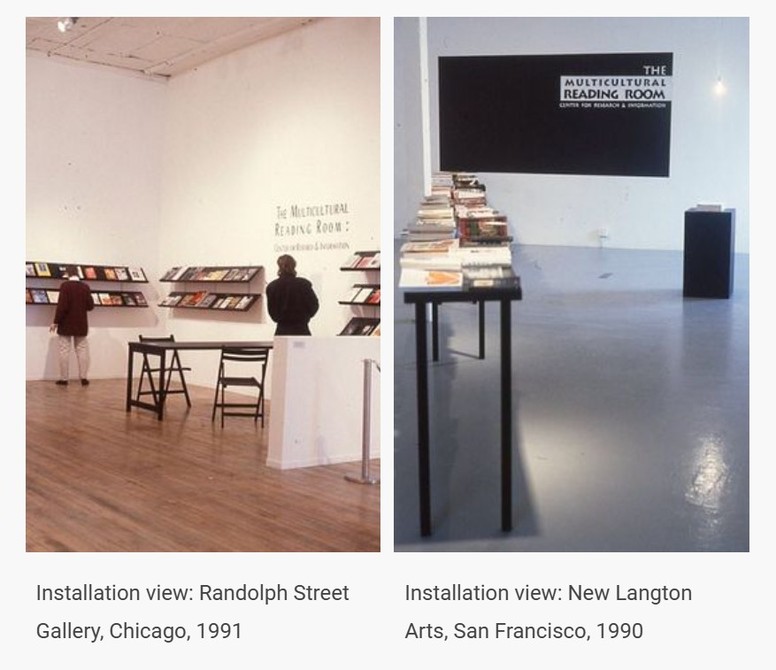
The Multicultural Reading Room: Center for Research and Information
In a nod to the venerated institution of the public library, Rascon conceived a project involving a selection of participating collaborators from different vantage points of the worlds of art and culture, to construct a reading room setting with a precise selection of books chosen by the invited participants. The gesture of opening participation to a cross section of 'collaborators' served to democratize the project space and to redefine the subject of public engagement in the social sphere. At close of the project the books were gifted to the library at San Francisco State University.
Multicultural Reading Room Exhibition pamphlet.
|
Installation view: Armando Rascón: Occupied Aztlán Adaline Kent Award Exhibition at the San Francisco Art Institute, 1994.
|
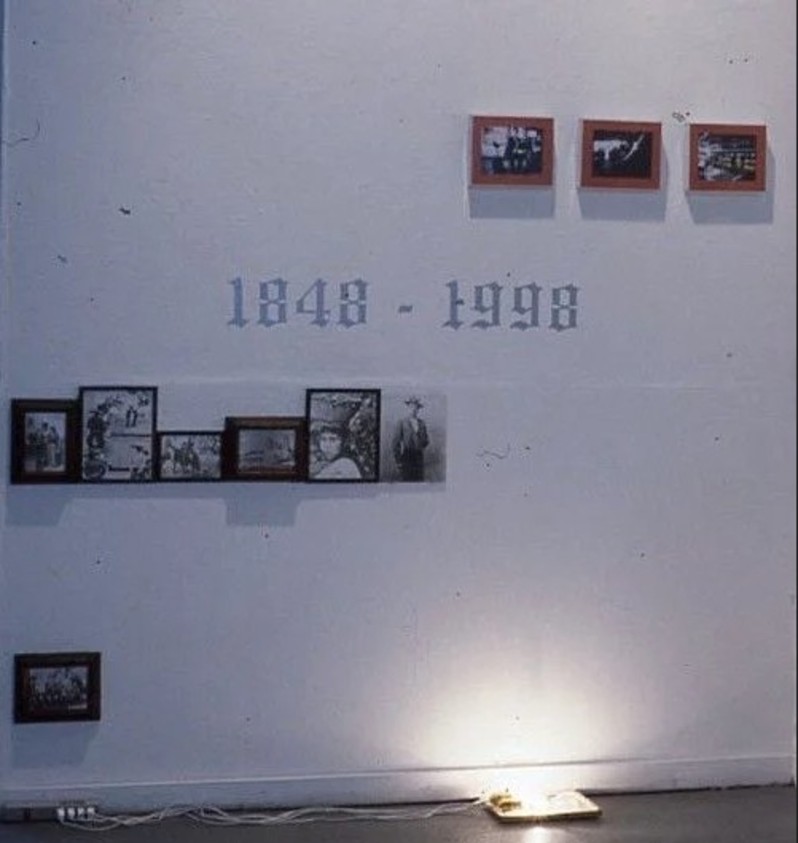
1848-1998 One Hundred Fifty Years Later, 1995, installation view at SOMARTS (South of Market Cultural Center) Exhibition curated by René Yañez and Jeff Nathanson.Mixed-media installation consisting of shelf with six antique photographs, vinyl signage, four lightbulbs upon a small stack of unframed antique photographs, electrical cords, small 4-prong power strip.
|
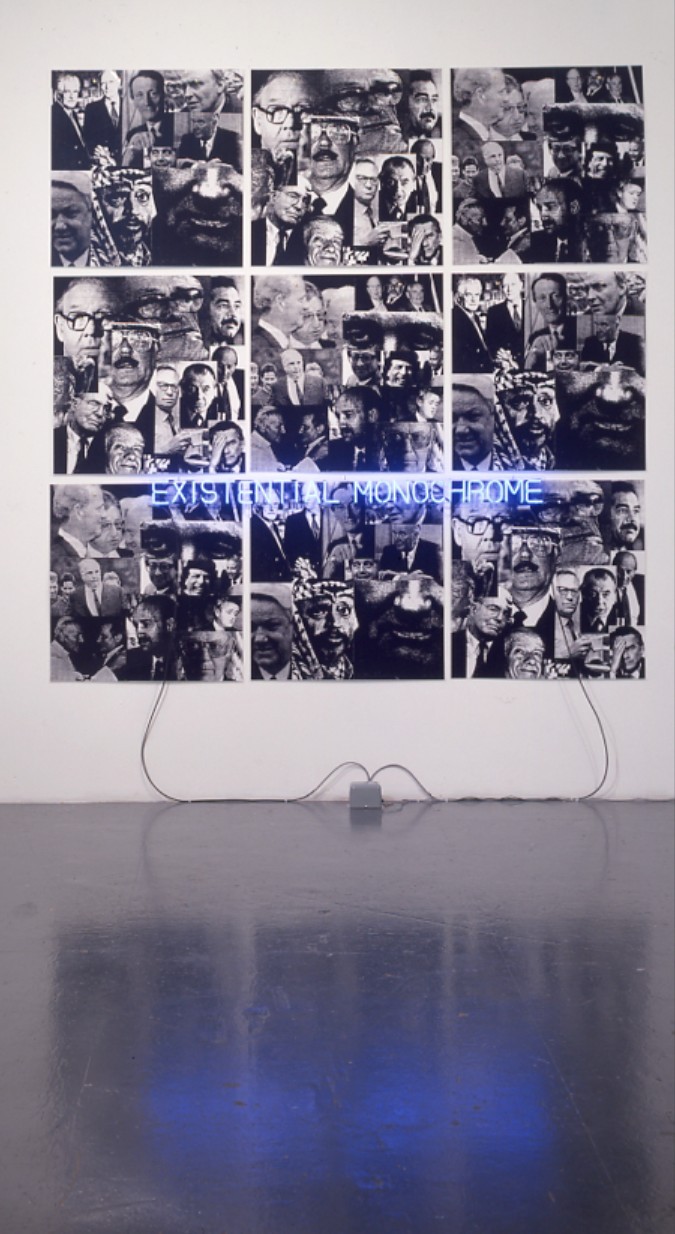
Existential Monochrome, 1990Armando Rascón 12 feet x 9 feet Neon, and oversized laminated xerox.
|
Armando Rascon: Decay and Resurrection
AIDS activist informed works 1981-1993
My arrival in San Francisco on St. Patrick's Day 1981 to take up residency in a cold-water warehouse studio on Folsom (at 11th) was a veritable thunderclap break from my past New York or Southern California life choices. The impact that AIDS was having in the City was an immediate departure, primarily visible upon the physiognomy of the gay male population at large. San Francisco is a boutique scale urban space, very densely populated and built vertically on a peninsula surrounded on three sides by water. In the early 80's one out of every four males was Gay. The per square-mile number of residents made the City feel even more condensed a civic polity and details tended to be more in-your-face in the neighborhoods, downtown, in the workplace and in general wherever residents were present. My first Saturday night at the Folsom studio, upon leaving the building to go to the corner store, I was immersed in a sea of leathermen that filled the sidewalks in all directions, necessitating me to walk on the streets with the cars to increase velocity and make progress to the store. By 1984 AIDS had rendered the Folsom Street leather district a complete ghost town and the myriad leather bars had closed, with only a few that still remained including the SF Eagle and the Powerhouse. The first work that I created in the Folsom studio reflected the pervading complexity of the pandemic that was killing off all of my friends. The zetgeist proclaimed an approaching APOCALYPSE and my first body of work, Decay and Resurrection, embodied that. Forty-five years later I see my own story arc reflected in those works as a testament to the AIDS activism and survivalist ethos that was created by all of the brave survivors of that era (1981-1993).
|
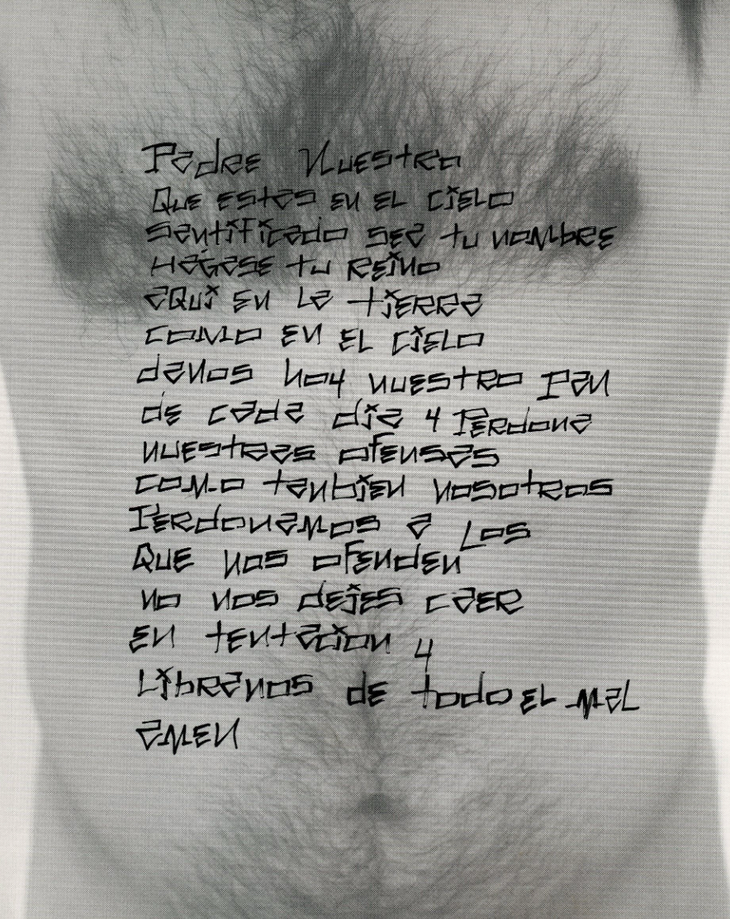
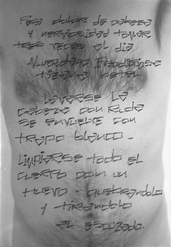
Self portrait (prayer), 1993 From the photo series Stations of the X (1989-1993).Ink on silverprint. From the body of work Decay and Resurrection 1981-1993
Self portrait (prayer) was published in the exhibition catalog Armando Rascon: Occupied Aztlan, Adalyn Kent Award exhibition at the San Francisco Art Institute, Spring 1994.
The following slide show features seven of the photographs from Station of the X.
|
Photo Album Gallery Place Holder - Please wait while the Photo Album loads.
If the album does not show, please refresh the page to try again.
|
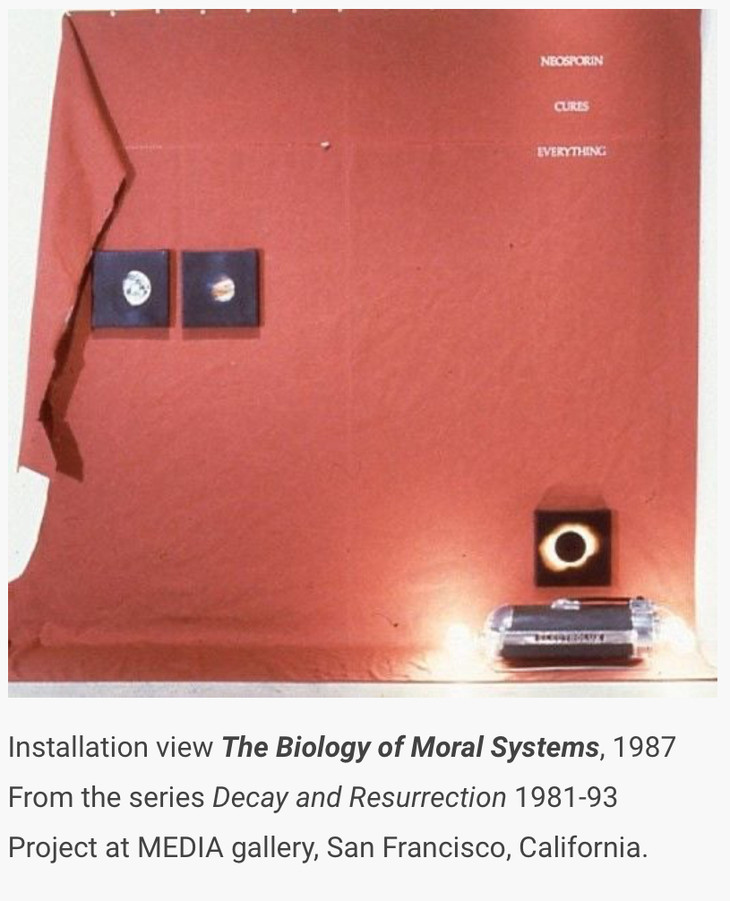
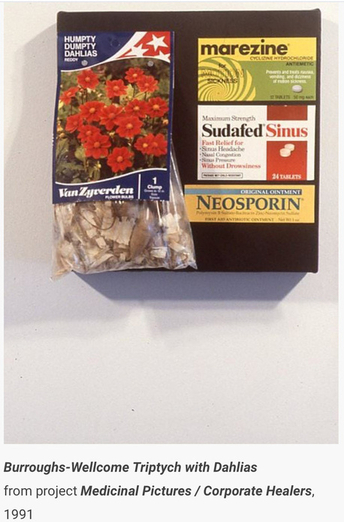
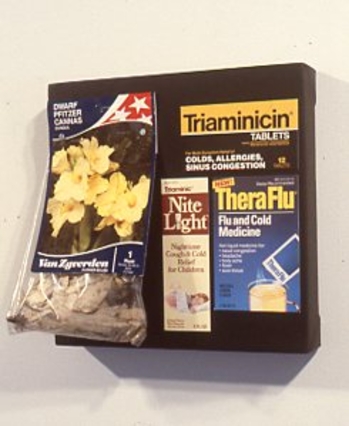
The pharmaceutical corporation Burroughs-Wellcome was a frontrunner in the production of AIDS treatments, yet it held a monopoly on access to treatment as the cost of the drug was prohibitively expensive for the average patient. It held the global patent numerous years as AIDS continued to spread globally during the height of the pandemic. Neosporin was one of the most popular over the counter topical antibiotics on the market, also the s ole property of the company. Rascón’s tableaux Biology of Moral Systems captures the ethical dynamic that pharma manufactures and markets with the text NEOSPORIN CURES EVERYTHING.
|
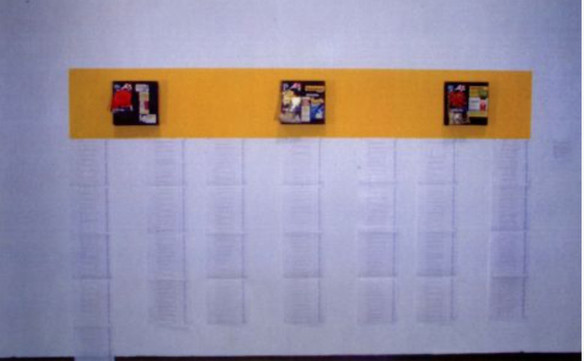
Medicinal Pictures / Corporate Healers, 1991 Installation view with three still lifes: Bristol-Meyers Triptych with Camelia Begonias, Sandoz Triptych with Gladioli, and Burroughs-Wellcome Triptych with Dahlias, --and numerous pages of automated research computer print-outs generated under t he subject headings (1) Pharmaceudical Industry, (2) Pharmaceudical Ethics, and (3) AIDS Research. A research project involving pharmaceudical corporations which are engaged in AIDS research and which sell over-the-counter drugs.
|
TERRAIN was born in 1987 from half of my cold-water warehouse space on Folsom at 11th, an artist run alternative space founded by my life partner Peter Wright and myself. TERRAIN held forth at the Folsom Street space through 1993, whereupon we vacated the space and relocated to Jessie Street behind the Palace Hotel to continue our mission of alternative programming in the San Francisco art scene. The framework of Decay and Resurrection pivoted to my XICANO.COM years, at the point of our move to downtown San Francisco -- the transition already evident with works such as Artifact with Three Declarations of Independence (1990) --with overarching Aztlán sovereignty messaging and my Xicanx political inclination and advent of a third space resulting in the XICANO.COM years (tu eres mi otro yo). Mosaic for Windows, an available freeware that I had used for my Occupied Aztlán Database in 1993, was soon packaged and marketed by Andresson as Netscape (1994), and the Well.com internet service provider went silent when raided by the FBI that same year —as the web exploded into the dot.com boom/bust era in Northern California. The Mission District was beginning to become co-opted by the tech bro overflow as it continued to impact the Bay Area overall. TERRAIN surfed that final wave as we held onto our seat as a private artist run alternative space independently financed through immense hard work and NO state nor federal funding ever. For a good part of my life TERRAIN was an extension of my critical project, until the tech disruptions and greedy landlord inspired our evacuation from heaven.
--Armando Rascón
|
Photo Album Gallery Place Holder - Please wait while the Photo Album loads.
If the album does not show, please refresh the page to try again.
|
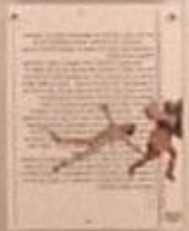
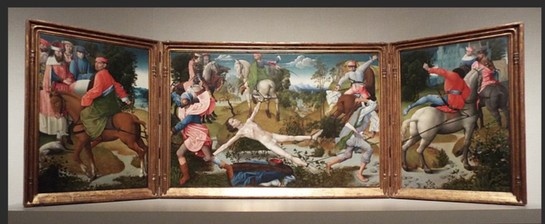
Untitled (Martyr Totem), 1989. Work featured
in the exhibition The AIDS Timeline organized by Group Material at the University Art Museum, UC Berkeley, California, 1990. The piece is a freestanding plexiglas panel containing pages of the Preliminary Injunction filed by the San Francisco Department of Public Health in 1984 that shut down the bath houses and places where men would gather to meet. The legal brief is superimposed with fragments of images of the drawing and quartering of St. Hippolytus from the diptych by Flemish artist Dirk Bouts (1415-1475). The work is a commentary on the state's slow-motion approach to the handling of the AIDS crisis in the City --an emergency perceived to be mostly concentrated within the LGBT community, though by 1987 it had spiraled throughout the planet and became a global emergency.
|
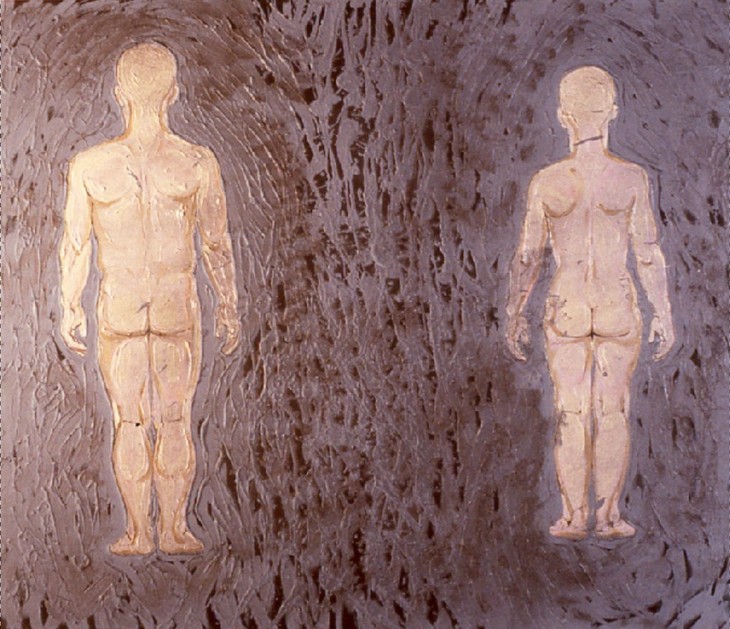
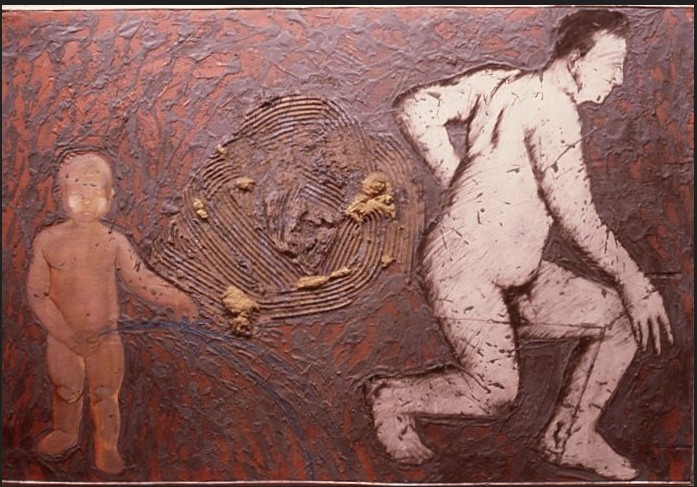
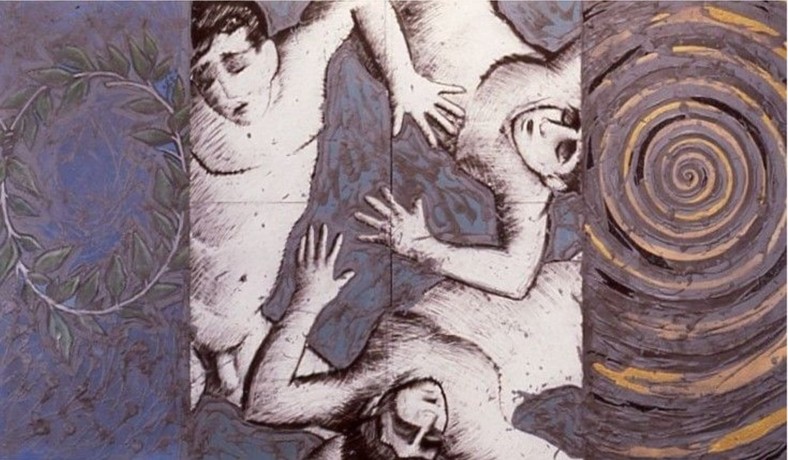
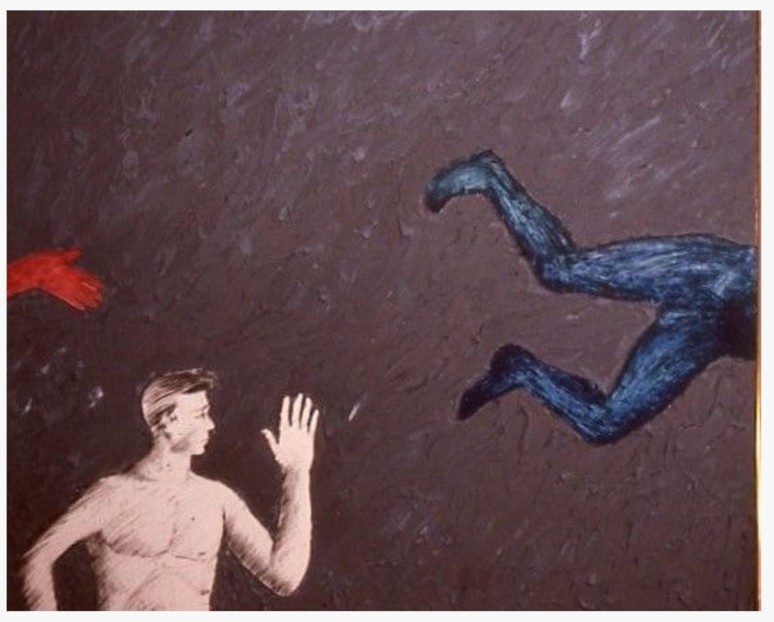
Three early mix-media works from DECAY AND RESURRECTION 1981-1993
Above: Untitled (Domine Mundi), 1984. Armando Rascón. From Decay and Resurrection 1981-1993, works from the Folsom Studio, San Francisco, California.
Middle panel: Untitled (Double Cryogenic), 1985. Armando Rascón. From Decay and Resurrection 1981-1993, works from the Folsom Studio, San Francisco, California.
Bottom: Untitled Ritual, 1985. Armando Rascón. From Decay and Resurrection 1981-1993, works from the Folsom Studio, San Francisco, California.
|
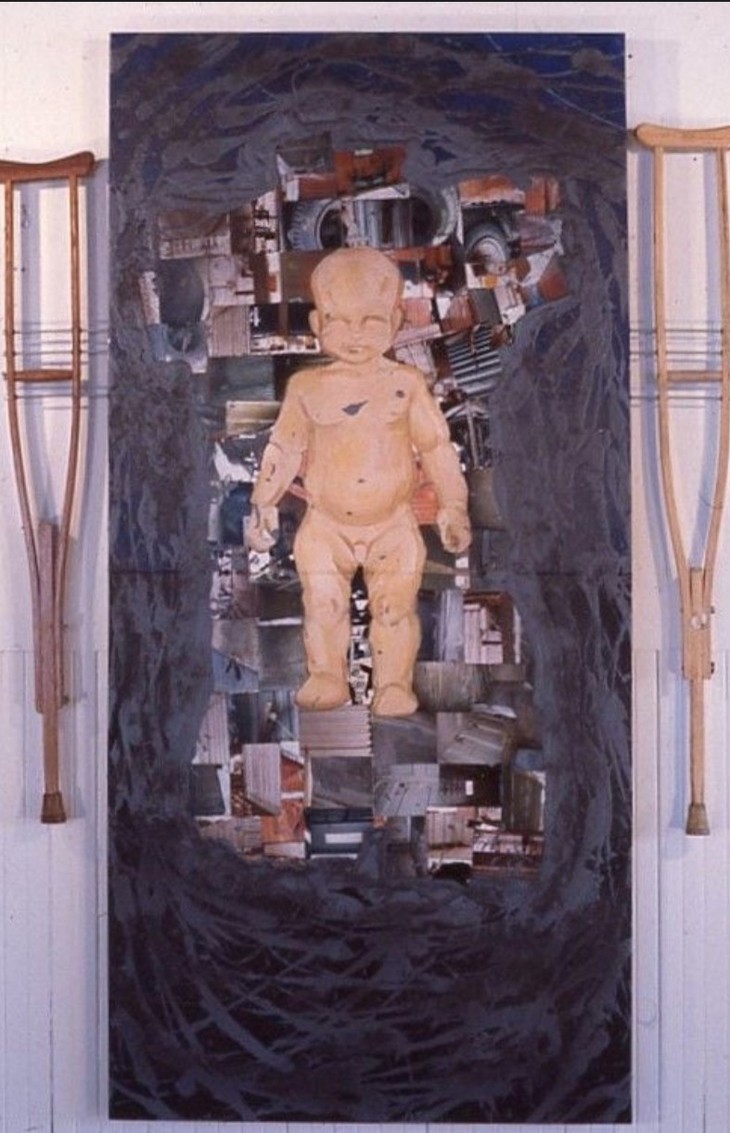
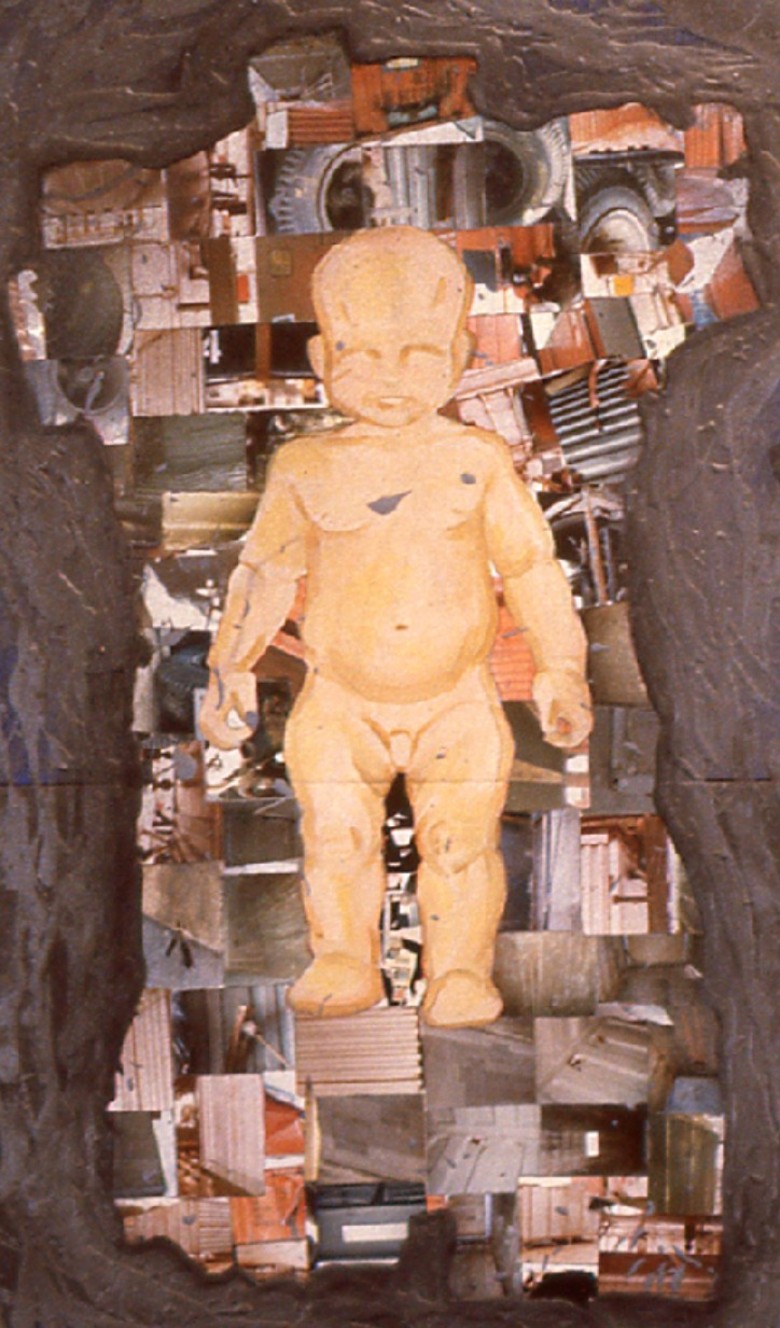
Untitled (ring vortex), 1986
Armando Rascón
From Decay and Resurrection 1981-1993
(In memory of David Cannon Dashiell, Félix González-Torres, and Irwin Irwin)
|
Youth Disguised as an Elder, 1982
Armando Rascón From Decay and Resurrection 1981-1993
|
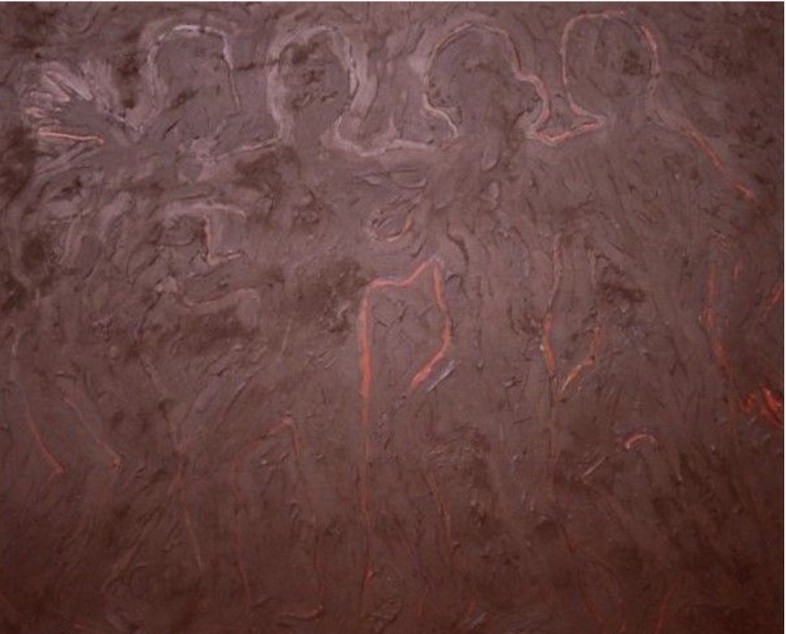
Prisoner Dance, 1982Armando Rascón From Decay and Resurrection 1981-1993
|
|
|