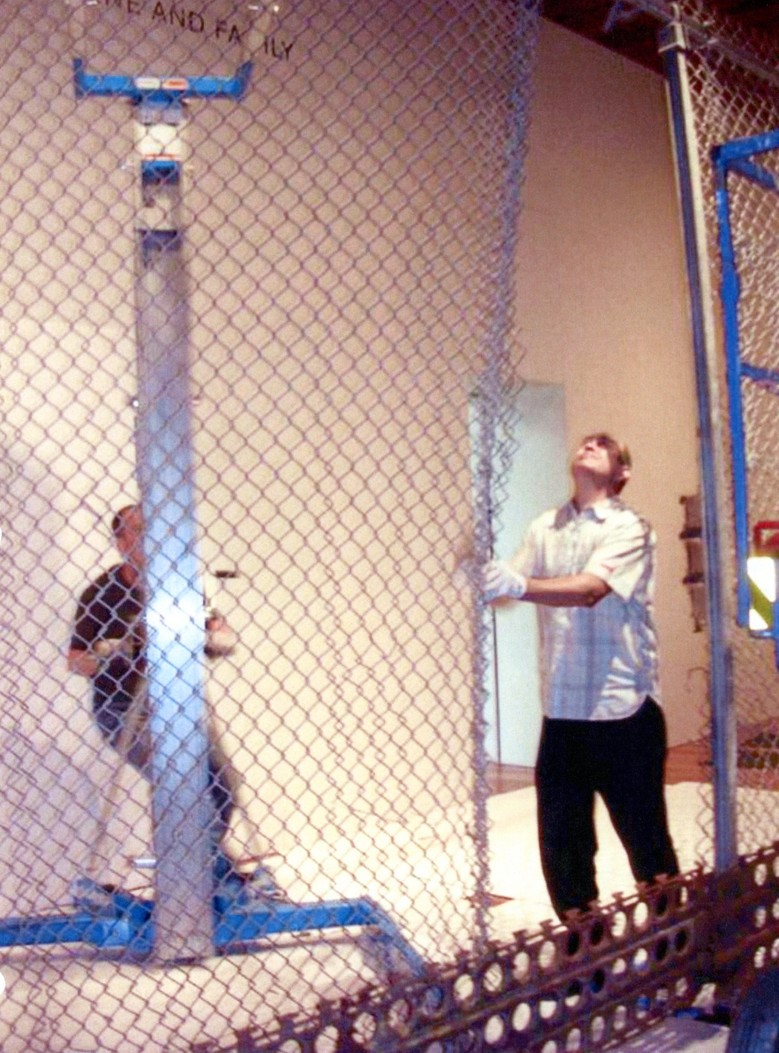
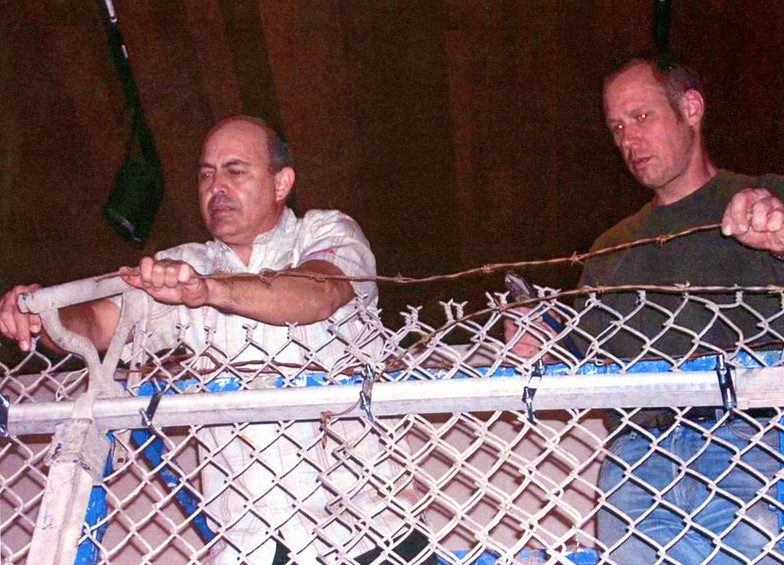
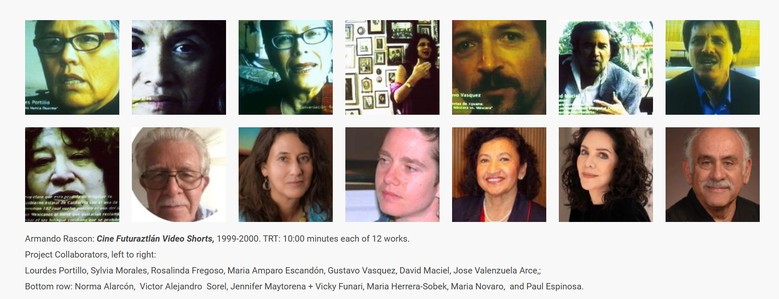
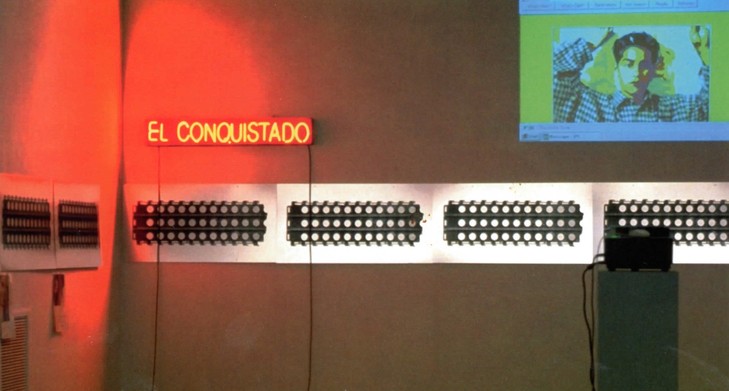
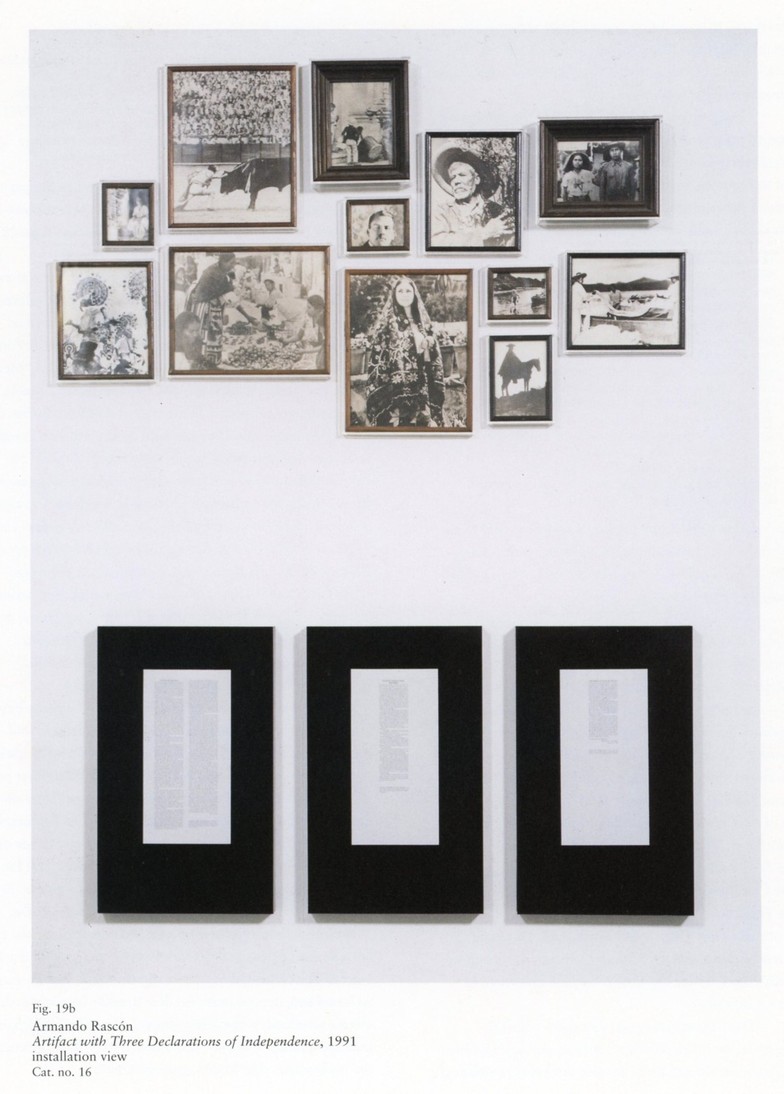
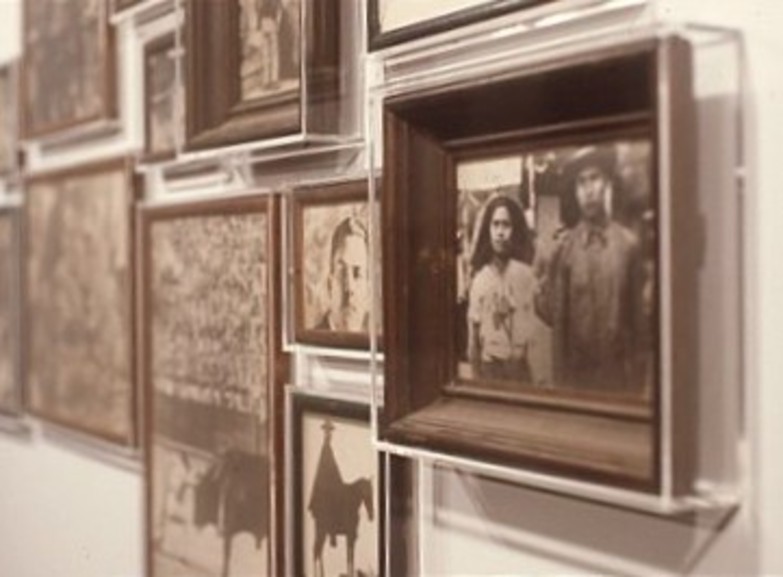
Institute for Xicano Relations: Portable Chapel Juan Soldado
©1993-2026 by Armando Rascón
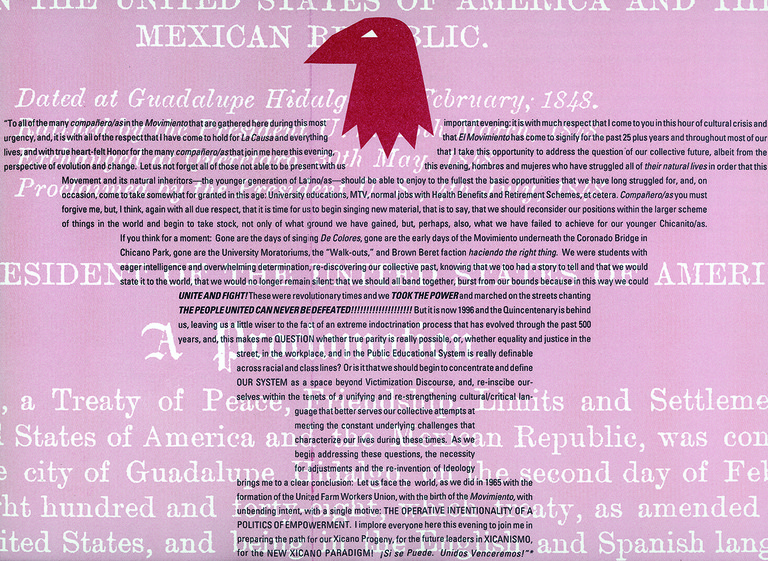
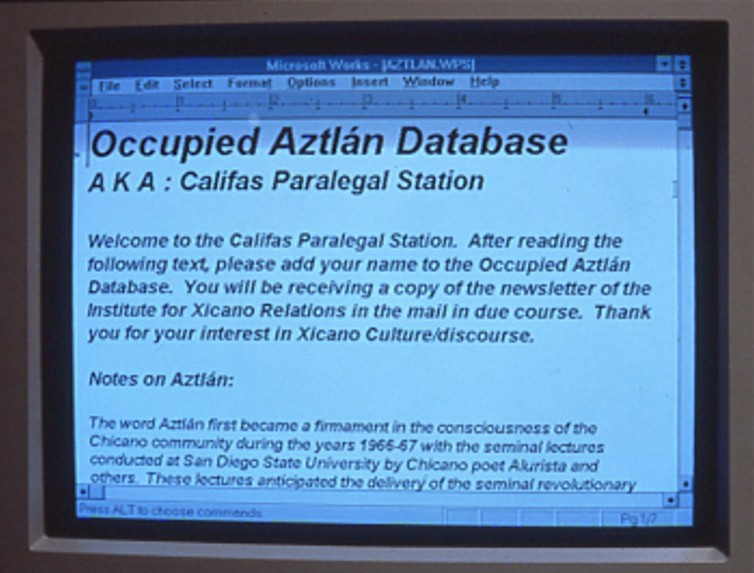
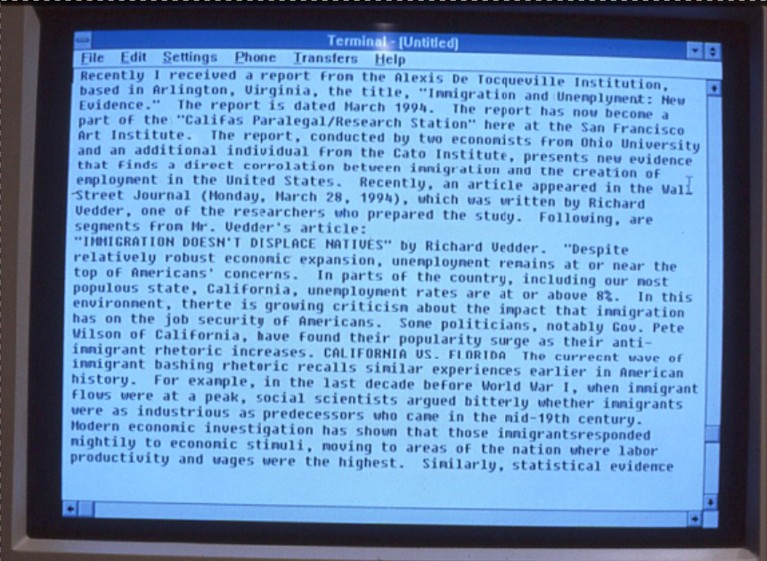
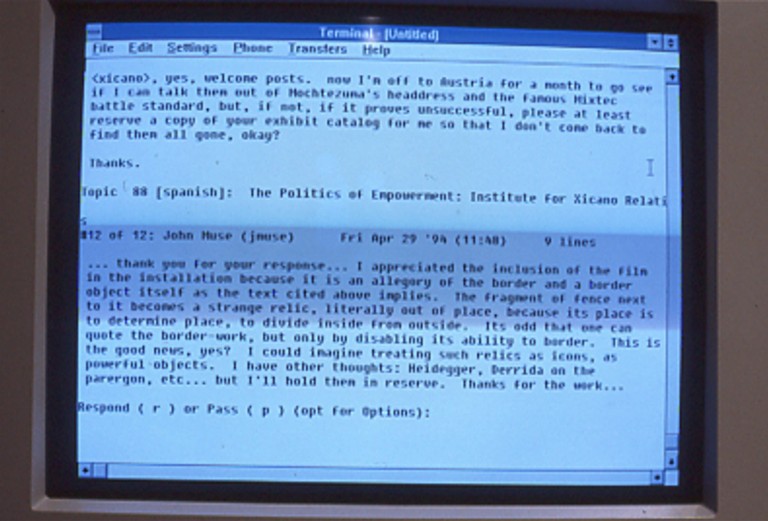
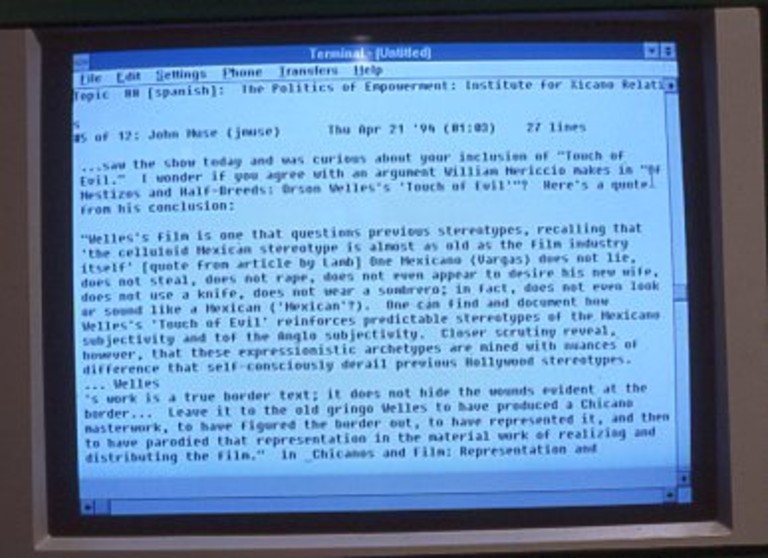
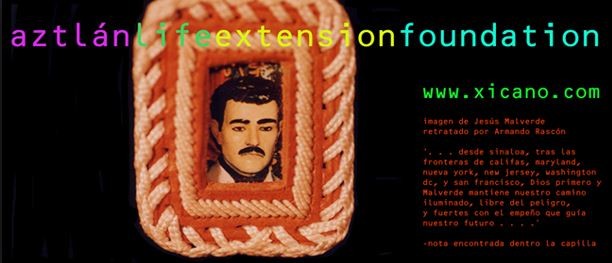
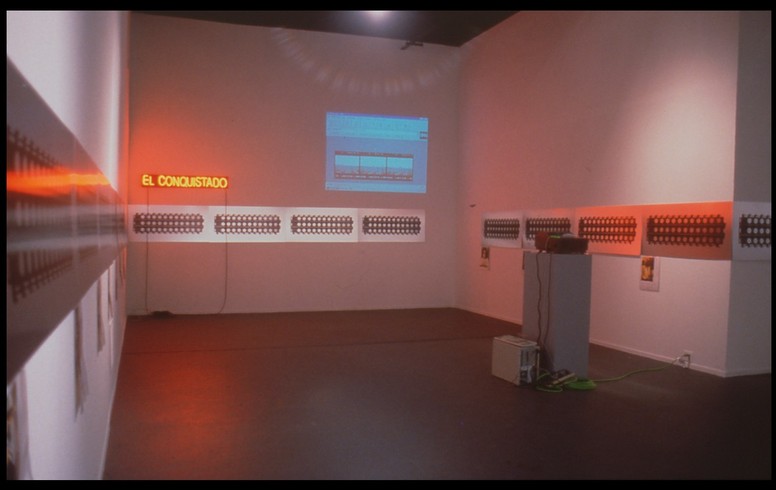
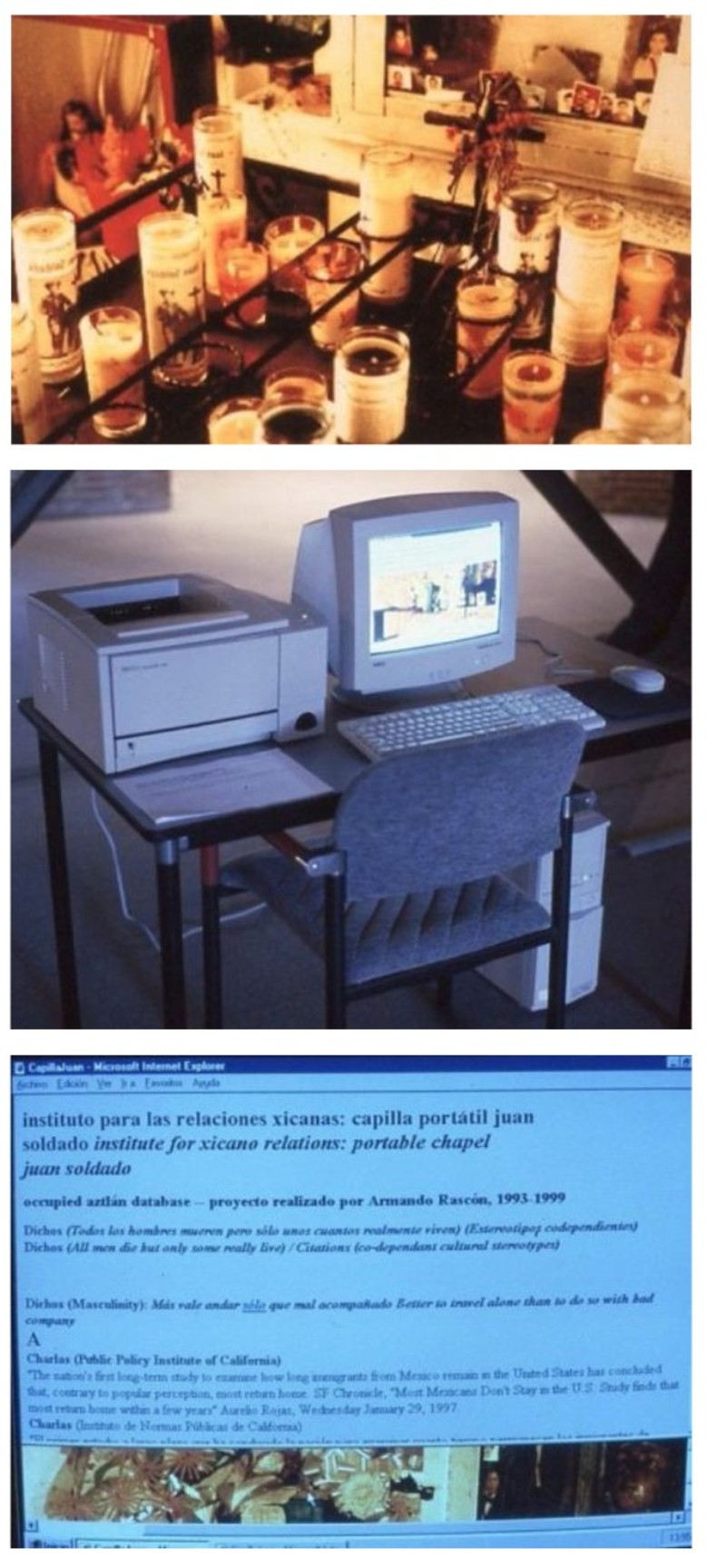
Html interactive computer station + bilingual information database published on xicano.com.
Commissioned as part of the exhibition Aztlán Hoy at Sala de Exposiciones Canal de Isabel II,
Madrid, Spain (satellite photography and new media center, part of Museo de Arte Reina Sofía.)
Aztlán Hoy curated by Berta Sichel. Travelled to the Bronx Museum in 2000.
Project researched, written, authored by Armando Rascón 1993-1997
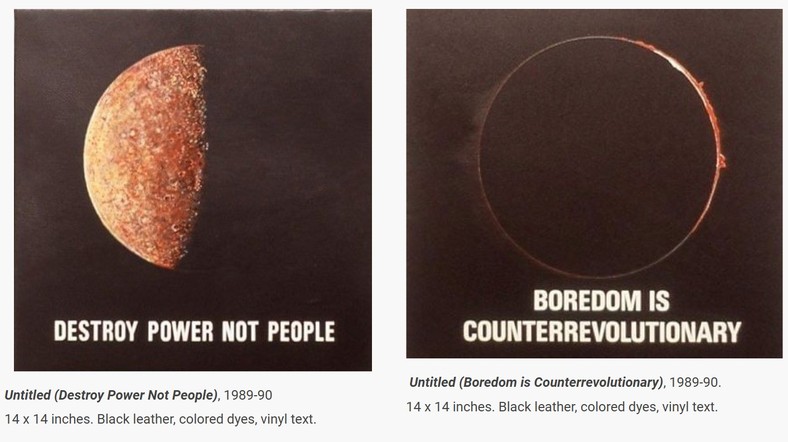
The online work operates as a self-guided tour of the Juan Soldado chapel located in Tijuana's old cemetery.
Viewers may scroll the alphabetized offerings/data citations and click on bold hyperlinked keywords to
prompt a photograph guided tour of the chapel. HTML site is currently undergoing recovery at 03/01/2026 -
check back for updates in progress.
[html recovery begin: Information Citations]
instituto para las relaciones xicanas: capilla portátil juan soldado
institute for xicano relations: portable chapel juan soldado
occupied aztlán database -- proyecto realizado por Armando Rascón, 1993-1999
Dichos (Todos los hombres mueren pero sólo unos cuantos realmente viven) (Estereotipos codependientes)
Dichos (All men die but only some really live) / Citations (co-dependant cultural stereotypes)
Dichos (Masculinity): Más vale andar sólo que mal acompañado Better to travel alone than to do so with bad company
A
Charlas (Public Policy Institute of California)
"The nation's first long-term study to examine how long immigrants from Mexico remain in the United States has
concluded that, contrary to popular perception, most return home. SF Chronicle, "Most Mexicans Don't Stay in the
U.S. Study finds that most return home within a few years" Aurelio Rojas, Wednesday January 29, 1997.
Charlas (Instituto de Normas Públicas de California)
"El primer estudio a largo plazo que ha conducido la nación para examinar cuanto tiempo permanecen los inmigrantes
de México en Estados Unidos, ha concluido que, contraria a la percepción pública, la mayoría regresa a su pais."
SF Chronicle, "La Mayoría de los Mexicanos No Pernanecen en E.U. Estudio concluye que la mayoría regresa a su
país en unos cuantos años" Aurelio Rojas, miércoles 29 de enero de 1997.
Dichos (Chicaneidad) No por mucho madrugar te amanece más temprano Earlier rising will not presage
an earlier sunrise
B
Charlas (Interiew)
"Q: The Senate's retiring immigration expert, Alan Simpson, says you have the worst job in the world.
Meissner: I read where he said that. Well I think the Immigration Service is a fascinating place. I don't think that in
my lifetime the immigration issue has ever had the saliency and the resonance that it has in thismoment. This is the
second-largest immigration period in our country's history. Only a few years ago, we had about 300,000 naturalizations a
year. In 1994 that jumped to about 500,000 and in 1995 to 1,000,000. And with the new welfare reform legislation that Congress has just passed [which prevents non-citizens from getting public assistance], I suspect the numbers will go up.
Q: To curb illegal immigration from Mexico, Pat Buchanan has suggested a fence along the Southwest border.
Meissner: How are we going to do that? What Buchanan is missing is that 'the border' is alot bigger than our 2,000-mile
frontier with Mexico. Our borders are also the beaches of Florida, the airports and overseas consulates where visas are i
ssued. About 40 percent of the illegal immigrants in this country are people who have overstayed legally issued
documents." The New York Times Magazine, "The Worst Job in the World? With a few recent victories in the very-shrill immigration debate, Doris Meissner, the I.N.S. Commissioner, has kept the nativists in Congress at bay --for now."
Claudia Dreifus, October 27, 1996.
Charlas (Entrevista)
"Pr: El experto de inmigración saliente, Alan Simpson, dice que Ud. tiene el peor empleo del mundo.
Meissner: Leí que dijo eso. Bueno, yo creo que el Servicio de Inmigración es un lugar fascinante. Creo que en toda mi
vida el tema de inmigración no ha tenido la notabilidad y resonancia que tiene en este momento. Este es el segundo
periodo de mayor inmigración en la historia de nuestro país. Hace sólo algunos años, teníamos como 300,000
naturalizaciones al año. En 1994 saltamos a 500,000 y en 1995 a 1,000,000. Y con la nueva reforma legislativa
de asistencia pública [la cual impide que personas que no son ciudadanas reciban asistencia pública], sospecho
que incrementarán los números.
Pr: Para frenar la inmigración ilegal de México, Pat Buchanan ha sugerido una valla a lo largo de la fronterasudoeste.
Meissner: ¿Cómo vamos a hacer eso? Lo que no entiende Buchanan es que 'la frontera' es mucho más grandeque
nuestra frontera de 2,000 millas con México. Nuestras fronteras también son las playas de Florida, los aeropuertos
y los consulados en el extranjero donde se expiden visas. Aproximadamente 40 por ciento de los inmigrantes ilegales
en este país son personas que han permanecido más tiempo de lo estipulado en sus documentos expedidos legalmente."
The New York Times Magazine, "El Peor Empleo en el Mundo? Con unas cuantas victorias recientes en el debate de inmigración, Doris Meissner, Comisinada de la I.N.S. ha contenido anativistas en el Congreso --por lo pronto".
Claudia Dreifus, 27 de octubre de 1996.
Dichos (Spirituality) Ojos que no ven corazón que no siente What the eyes don't see the heart won't feel
C
Charlas (Silent Deaths)
"El Paso, Aug. 20 -- In police reports, they often have no names and are chiefly described by the clothes theywore
when their bodies were found . . . Some who die are never found, so no one knows the exact number of such fatalities
over all. But in the first systematic effort to study these deaths at the border, a recent report by the University of
Houston found that over the last four years, 1,185 people had drowned, died of exposure or dehydration or been hit
by automobiles while, the authorities concluded, they had been trying to cross the border away from designated
checkpoints." The New York Times, "Silent Deaths Climbing Steadily As Migrants Cross Mexico Border" by Sam Howe Verhovek. Sunday, August 24, 1997.
Charlas (Muriendo en Silencio)
"El Paso, Agosto 20 -- En reportes policiácos, no tienen nombre y son identificadas por la ropa que llevaban
cuando fueron encontradas . . . Algunas muertes no serán descubiertas, ni se sabe el número exacto de estas
fatalidades. Pero en el primer esfuerzo sistemático de investigar las muertes fronterizas, un reporte reciente de
la Universidad de Houston encontró que durante los últimos cuatro años, 1,185 personas se ahogaron,
congelaron o se ensolaron, o fueron atropelladas por autos mientras intentaban cruzar la frontera a una
distancia de los retenes oficiales." The New York Times, "Silent Deaths Climbing Steadily As Migrants Cross
Mexico Border" by Sam Howe Verhovek. Sunday, August 24, 1997.
Dichos (La Voz Latina) Está como mírame y déjame Look but don't touch
Ch
Charlas (Selena)
"Christy Haubegger, a Mexican-American from Houston who is publisher of Latina, a New York-based magazine
for Hispanic women, said "Selena is an icon to us because she is both culturally and physically like we are,
someone born here in the United States and definitely American, but also a Latina, proud of who she is and
able to say she didn't have to lose her culture to be successful. She not only embodied ideals of Latina beauty
but the struggle we live with every day, between two cultures, two languages and two sets of values." Even
before Selena was born, of course, Latinas like Rita Hayworth ad Raquel Welch had built large followings. But
they gained their fame only by changing their names, trying to discard their identities as Hispanic women and
projecting an exotic image that was sexy and submissive. That formula reinforced 'a stereotype of us being the
oppressed half of a partiarchy, which we certainly aren't,' as Ms. Haubegger put it. The New York Times, "A
Legend Grows, and So Does an Industry" Larry Rohter, January 12, 1997.
Charlas (Selena)
"Christy Haubegger, una mexicoamericana de Houston que publica Latina, una revista con base en Nueva York
para mujeres hispanas, dijo "Selena es un ícono para nosotras porque es culturalmente y físicamente como
nosotras, alguien nacida aquí en Estados Unidos y definitivamente americana, pero también latina, orgullosa de
quien es y capaz de decir que no perdió su cultura para ser exitosa. No solamente encama los ideales de la
belleza latina, también la lucha que vivimos cada día, entre dos culturas, dos idiomas y dos tipos de valores
diferentes." Aún antes de nacer Selena, por supuesto, latinas como Rita Hayworth y Raquel Welch habían
adquirido grandes números de seguidores. Pero obtuvieron su fama sólo al carnbiar sus nombres, tratando de
desechar sus identidades de mujeres hispanas y proyectando una imagen exótica que era sexy y sumisa. Esta
fórmula reforzó 'el estereotipo de que somos la mitad oprimida de un patriarcado, que en verdad no somos,'
como dijera la Srita. Haubegger." The New York Times, "Crece una Leyenda, También una Industria" Larry
Rohter, 12 de enero de 1997.
Dichos (Immigration) Andamos de Herodas a Pilatos We go here and there and do not find our place
D
Charlas (Redistricting 11)
"Washington, Nov. 12-- The Supreme Court today threw into doubt the future of the first Hispanic-majority
Congressional district in the Midwest, setting aside a lower court's decision that found the oddly shaped Illinois
district to be constitutional." The New York , "Setback for Hispanic Congressional District" Linda Greenhouse,
November 13, 1996.
CharIas (Cambio de Distrito 11)
"Washington, 12 de nov. --La Suprema Corte hoy echó a duda el futuro del primer distrito Congresional de
mayoría hispana en el área central de Estados Unidos, dejando a un lado la decisión de un tribunal menor que
dictó que este distrito extrañamente configurado de Illinois es constitucional." The New York Times, "Atraso
para el Distrito Congresional Hispano" Linda Greenhouse, 13 de noviembre de 1996.
Dichos (Cultural Space) No hay mal que por bien no venga The road to hell is paved with good intentions
E
Charlas (Sanctuary)
"The INS will continue to operate with a fixed formula of enforcement priorities. "We spend 30 percent of our
time on criminal aliens, 30 percent on employer sanctions, and 30 percent on fraud and counterfeit
documents," said Schiltgen [Director, INS San Francisco]. "We need to spread [the remaining IO percent] out
to all the areas, including finding John Doe who is an illegal alien. Those have been our priorities. Quite
frankly, I don't see them changing in the next year." Schitgen refused to portay himself as different from his
predecessor, Republican appointed David Ilchert, who was criticized by civil rights and immigration advocates
as being too harsh with immigrants. Ilchert orchestrated numerous INS sweeps of Mission District
establishments frequented by Latinos. In the mid'80s Patricia Aguayo, then a producer for Channel 44 (she is
now board president of the Mission Economic and Cultural Association), was swept up in a raid at the Mission
nightspot Club Elegante. "It was a reign of terror," said Aguayo. "I saw firsthand how inhumane the INS was."
Public criticism of the Club Elegante raid eventually led to the city's passage of a sanctuary ordinance to limit
INS abuses in San Francisco. San Francisco Bqy Guardian, "Welcome to ground zero: San Francisco's new INS
chief says the agency can't afford to enforce Prop. 187 -- but defends past abusive policies." Eric Stephan,
December 7, 1994.
Charlas (Santuario)
"El Servicio de Inmigración y Naturalización continuará operando con una fórmula fija de prioridades para hacer
cumplir la ley. "Gastamos 30 por ciento de nuestro tiempo en extranjeros criminales, 30 por ciento
sancionando patrones y 30 por ciento en fraude y documentos falsificados," dijo Schiltgen [Director, INS San
Francisco]. "Necesitamos repartir [el IO por ciento restante] a todas las áreas, incluso para hallar a ilegales
perdidos. Esas han sido nuestras prioridades. Francamente, no creo que vayan a cambiar el año próximo".
Schitgen se rehusó a presentarse como diferente a su antecesor, el Republicano designado David Ilchert, quien
fue criticado por defensores pro derechos humanos y de inmigrantes como demasiado severo con los
inmigrantes. Ilchert organizó numerosas barridas en establecimientos del Mission District frecuentados por
latinos. A mediados de los 80, Patricia Aguayo, la entonces productora del Canal 44 (ahora es presidenta de la
Asociación Cultural y Económica de Mission), fue detenida en una razzia en el club nocturno Club Elegante.
"Era un reinado de terror", dijo Aguayo. "Yo misma vi lo inhumano que era el INS". Críticas públicas sobre la
razzia del Club Elegante eventualmente causaron una orden de refugio para limitar los abusos del INS en San
Francisco. San Francisco Bay Guardian, "Bienvenidos al punto cero: El nuevo jefe del INS de San Francisco dice
que la agencia no tiene el dinero para hacer cumplir la Prop. 187 -pero defiende politicas abusivas del pasado".
Eric Stephan, 7 de diciembre de 1994.
Dichos (Corazón) El que nace para tamal del cielo le caen las hojas The tenor's voice is a gift from heaven
F
Charlas (Prensa)
"Habla usted Español? For magazine publishers the answer is sí. Big publishers, and publishers who want to
become big, are busy launching magazines for the Hispanic market. The likes of Newsweek, People and Men's
Health are joining a field already crowded with titles such as Sí, Latina, Latina Style, and Frontera." San
Francisco Chronicle, "Hispanic Gloss - Publishers and advertisers have discovered wealth of readers in untapped
market" David Armstrong, Sunday January 12, 1997.
Charlas (Prensa)
"Habla usted español? Para muchas editoriales de revistas la respuesta es sí. Las grandes editoriales y
editoriales que quieren expanderse, se están ocupando de lanzar revistas para el mercado hispano. Revistas
similares a Newsweek, People y Men's Health están emergiendo en un carnpo ya repleto de títulos como Sí,
Latina, Latina Style y Frontera". San Francisco Chronicle, "Brillo Hispano - Editoriales y publicistas han
descubierto una abundancia de lectores en un mercado no explotado" David Armstrong, domingo 12 de enero
de 1997.
Dichos (Por Vida) Nunca apuntes con un dedo porque tres te apuntaran a ti Never point with onefinger
because three shall point back in return
G
Charlas (Coordinadora 96)
"People are really concerned," said Juan Martinez from East Lansing, Michigan, as he walked alongside his
father, Efrain, who came from Mexico 73 years ago and whose great-grandfather was bom in San Antonio,
when it was still part of Mexico. "They hear Spanish spoken at the grocery store or at the K-Mart, and they
say, 'My God, we're being invaded.' But if you really look at it, what was the first European language that was
spoken in this hemisphere. It wasn't English." The New York Times, "In Capital, Crowd seeks Immigrants'
Ethnic Rights" Steven A. Holmes, Sunday October 13, 1996.
Charlas (Coordinadora 96)
"La gente está muy preocupada", dijo Juan Martinez de East Lansing, Michigan, mientras caminaba junto a su
padre, Efrain, quien vino de México hace 73 años y cuyo bisabuelo nació en San Antonio cuando aún formaba
parte de México. "Escuchan español en el mercado y en el K-Mart y dicen, 'Dios mío, nos están invadiendo.'
Pero si te pones a pensar cuál fue el primer idioma europeo que se habló en este hemisferio. No fue el inglés."
The New York Times, "En la Capital, la Muchedumbre Busca los Derechos Etnicos de los Inmigrantes". Steven A.
Holmes, domingo 13 de octubre de 1996.
Dichos (Risas) Primero son los dientes que los parientes Yourself first, others last
H
Charlas (Travel)
"Nogales is the Spanish word for walnuts. It is said that when the city was named in 1854, two identical
walnut trees mirrored each other on opposite sides of the border. There is no sign of those trees in this
burgeoning, but still mostly poor, metropolis. Ambos Nogales --"both Nogales"-- is economically and
spiritually one city, separated but not divided, by a wire fence. It was here, in 1882, that Mexico was first
connected to the United States by rail. Now, because of hotly contested immigration laws, the heavily policed
border is ominous, but the folklorist James Griffith documented a practice common in the 1980's: international
volleyball games, with the wire fence serving as the net." The New York Times, "Jewels of the Desert- Savoring
the border cultures and saguaro cactuses on a weekend drive from Tucson into Mexico" Kim Westerman,
January 26, 1997.
Charlas (Viajes)
"Los nogales son los árboles que dan las nueces. Se dice que cuando la ciudad fue nombrada en 1854, dos
nogales idénticos habían crecido frente a frente en lados opuestos de la frontera. No queda señal de estos
árboles en esta metropolis pujante, aunque en su mayor parte pobre. Ambos Nogales son económicamente y
espiritualmente una ciudad, separada pero no dividida por una cerca de alambre. Fue aquí en 1882 que por
primera vez México se conectó con Estados Unidos a través del ferrocarril. Ahora, por las reñidas leyes de
inmigración, la frontera, altamente vigilada es amenazadora. Pero el folclorista James Griffith documentó una
práctica común en los 80: juegos de volibol internacionales, con la cerca de alambre usada como red". The New
York Times, "Joyas del Desierto - Saboreando las culturas fronterizas y los saguaro en un paseo de fin de
semana en auto de Tucson a México" Kim Westerman, 26 de enero de 1997.
Dichos (Espectro) Fue por lana y salió trasquilado Went for wool and returned hairless
I
Charlas (DMV)
"Sometime next year, clerks in every Department of Motor Vehicles field office, from Tule Lake to Calexico, will
be able to match the faces of driver's license renewal applicants with photos called up by the computer. And
the long reach of the new immigration legislation will have been extended once again." San Francisco
Exarniner, "Immigrants feel the noose tightening" Eric Brazil, Sunday October 13, 1996.
Charlas (DMV)
"El año que entra, los empleados en todas las oficinas de campo del Departamento de Vehículos Motorizados,
desde Tule Lake hasta Calexico, podrán verificar las caras de quienes soliciten la renovación de su licencia con
fotos en una computadora. El largo alcance de la nueva legislación de inmigración ha sido extendido una vez
más. San Francisco Examiner, "Los inmigrantes sienten la soga apretando" Eric Brazil, domingo 13 de octubre
de 1996.
Dichos (Infinitos) Solo borracho y dormido no se siente lo jodido Only drunk and asleep are the wretched
desensitized
J
Charlas (social space)
"In urban struggles ... the politics of space is closely connected to the formation of collective identities that
are grounded in particular interpretations of the past. In this regard, Stuart Hall's discussion of the
relationship between identity and history is instructive. He argues that cultural identities are not fixed in a
single or hidden history but are "subject to the continuous play of history, culture, and power. Far from being
grounded in a mere 'recovery' of a past just waiting to be found, . . . identities are the names we give to the
different ways we are positioned by, and position ourselves within, the narratives of the past." Conquests and
Historical Identities in California: 1769 - 1936, Lisbeth Haas, University of California Press, 1995.
Charlas (espacio social)
"En luchas urbanas las políticas de espacio se conectan a la formación de identidades colectivas enraizadas en
interpretaciones particulates del pasado. En este caso, el debate de Stuart Hall sobre la relación entre
identidad e historia es instructive. Arguye que las identidades culturales no están fijas en una sola o escondida
historia sino que están "sujetas al continuo paso de la historia, la cultura y el poder. Lejos de estar enraizadas
en solamente "recobrar" el pasado esperando ser hallado, . . . las identidades son los nombres que les damos a
las diferentes maneras en las que estamos colocados y nos colocamos dentro de las narratives del pasado".
Conquests and Historical Identities in California: 1769 - 1936, Lisbeth Haas, University of California Press,
1995.
Dichos (discovery/transformation/transcendence/actualization) Camar6n que se duerme se lo lleva la
corriente Slhe who snoozes looses
K
Charlas (Obituary)
"Austin, Tex., July 28 -- Hector Perez Garcia, a South Texas doctor who founded one of the nation's most
influential Mexican-American civil rights organizations, died on Friday in Memorial Medical Center in Corpus
Christi, Tex. The New York Times, "Hector Perez Garcia, 82, Dies; Led Hispanic Rights Group" obituary, July 29,
1996.
Charlas (Obituario)
"Austin, Tex, 28 de julio -- Héctor Pérez García, un médico del sur de Texas quien fundó una de las
organizaciones mexicoamericanas más influyentes pro derechos civiles, murió el viernes en el Memorial Medical
Center en Corpus Christi, Tex." The New York Times, Héctor Pérez García, 82, Muere; Dirigió Grupo Pro Derechos
Hispanos" obituario, 29 de julio de 1996.
Dichos (Calaca Olmeca/Calaca Postcolonial) Limosnero con garrote Beggars Can't be Choosers
L
Charlas (Acâgchemem Neophytes)
The 1775 erection of a cross and celebration of mass on an Acâgchemem religious site was followed shortly by
the Spaniards' retreat to the presidio at San Diego as a result of an Indian revolt against the Mission San Diego.
It was therefore not until one year later that the process of buildng a mission and converting the Acâgchemem
population began. The vast majority of initial converts at San Juan Capistrano were children, a common
pattern in most of the missions. The children were likely brought by their parents to make alliances with the
missionaries, who not only possessed new knowledge and goods but also presented the threat of force. The
military was in fact crucial to the encounter between missionaries and potential converts, even though most
soldiers and Spanish settlers did not live near either the missions or Indian villages. One confrontation
between Father Serra, the president of the California missions and head pf the colonization effort in California,
and a number of arned Acâgchemem illustrates the relations of power that sustained this colonial encounter.
Father Serra was approaching San Juan Capistrano from the north, having left Mission San Gabriel with
livestock and neophytes who would help build the mission and serve as interpreters for the priests. The group
had divided, and Father Serra was traveling in the company of one soldier and one neophyte. As they entered
Acâgchemem territory, these three suddenly found themselves surroundeed by a crowd of painted and well-
armed Indians, some of whom put arrows to their bowstrings as though they intended to kill the Spanish
intruders. The neophyte, however, shouted in their language that they should not hurt the missionary
because many soldiers were coming behind who would kill them all. Accordingly, they desisted, aware of the
serious threat that military retaliation represented." Conquests and Historical Identities in California: 1769 -
1936, Lisbeth Haas, University of California Press, 1995.
Charlas (Neófitos de Acâgchemem)
En 1775 la erección de una cruz y la celebración de una misa en un sitio religiose Acâgchemem fueron seguidas
por la retirada de los españoles al presidio en San Diego como resultado de una insurgencia india contra la
Misión de San Diego. Por lo tanto, no fue hasta un año más tarde que comenzó el proceso de construcción de
una misión y la conversión de la población Acâgchemem. Inicialmente la gran mayoría de converses en San
Juan Capistrano eran niños, lo cual era común en la mayor parte de las misiones. Los niños eran traidos por
sus padres para hacer alianzas con los misioneros, quienes no sólo poseían nuevos conocimientos y bienes
materiales sino que también presentaban una fuerza amenazadora. Las fuerzas militates eran de hecho
cruciales en el encuentro entre misioneros y converses potenciales, aunque la mayoría de los soldados y
colonizadores españoles no vivían cerca de las misiones o los poblados indios. Una confrontación entre el
Padre Serra, el presidente de las misiones de California y lider de la colonización de California y un grupo de
Acâgchemem armados, ilustra las relaciones de poder en este encuentro colonial. El Padre Serra se acercaba a
San Juan Capistrano desde el norte, habiendo dejado la Misi6n San Gabriel con ganado y neófitos que le
ayudarían a construir la misión y servirían de intérpretes para los sacerdotes. El grupo se había dividido, y el
Padre Serra viajaba en compañía de un soldado y un neófito. Al entrar a territorio Acâgchemem, los tres de
repente se encontraron rodeados por una multitud de indios pintados y bien armados, algunos de los cuales
Ilevaron flechas a sus arcos como si tuvieran intenciones de matar a los intrusos españoles. Sin embargo, el
neófito gritó en su idioma que no debían lastimar al misionero ya que muchos soldados venían detrás de ellos y
los matarían a todos. En consecuencia, desistieron, conscientes de la seria amenaza que representaba una
represalia militar. Conquests and Historical Identities in California: 1769 - 1936, Lisbeth Haas, University of
California Press, 1995.
Dichos (Divinity) El que al cielo escupe a la cara le cae Spit at the sky, it falls on your face
Ll
CharIas (Olmeca Time / Postcolonial Time)
Especially in cultural critique, the event of political independence can be automatically assumed to stand in-
between colony and decolonization as an unexamined good that operates a reversal. As I am insisting, the
new nation is run by a regulative logic derived from a reversal of the old colony from within the cited episteme
of the postcolonial subject: secularism, democracy, socialism, national identity, capitalist development. There
is however a space that did not share in the energy of this reversal, a space that had no firmly established
agency of traffic with the culture of imperialism. Paradoxically, this space is also outside of organized labor,
below the attempted reversals of capital logic. Conventionally, this space is described as the habitat of the
subproletariat or the subaltern ... this is the space of the displacement of the colonization-decolonization
reversal. This is the space that can become, for her, a dystopic representation of decolonization as such. In
this context, "decolonization" becomes only a convenient and misleading word, used because no other can be
found. Outside in the Teaching Machine, by Gayatri Chakravorty Spivak, Routledge, New York & London, 1993.
Charlas (Tiempo Olmeca / Tiempo Poscolonial)
Especialmente en la crítica cultural, el evento de independencia política puede automáticamente suponerse
entre colonia y decolonización como un bien no examinado que opera una inversión. Como insisto, la nueva
nación es manejada por una lógica reguladora derivada de la inversión de la vieja colonia dentro del epístema
citado del tema poscolonial: secularismo, democracia, socialismo, identidad nacional, desarrollo capitalista.
Existe sin embargo, un espacio que no compartió la energia de esta inversión, un espacio que no tenía una
agencia firmemente establecida de tráfico con la cultura del imperialismo. Paradójicamente, este espacio
también se encuentra fuera de la organización laboral, debajo de los intentos de inversión de la lógica del
capital. Convencionalmente, este espacio es descrito como el hábitat del subproletariado o el subalterno este
es el espacio del desplazamiento de la inversión de colonización-decolonización. Este es el espacio que puede
convertirse, según ella, en una representación distópica de la decolonización como tal. En este contexto,
"decolonización" se convierte en una palabra conveniente y engañosa, usada por falta de otra. Outside in the
Teaching Machine, por Gayatri Chakravorty Spivak, Routledge, New York & London, 1993.
Dichos (Maternidad) Vale más una paloma en mano que cien volando A bird in the hand is worth two in
the bush
M
Charlas (Detention)
"... detention of illegal immigrants like this have risen in the past year in all the nine Border Patrol sectors
along the United States - Mexico border. And the Immigration and Naturalization Service, one of the few
Federal agencies to have a large budget increase approved by the Republican-controlled Congress, is hiring
1,000 new agents to patrol the border, a 20 percent increase in the size of the force. The increase also allow
the agency to expand its technological resources, like motion sensors, night-vision devices and a computerized
fingerprint file for every detainee." The New York Times, Tuesday February 13, 1996.
Charlas (Detención)
". . . las detenciones de inmigrantes ilegales como esta han incrementado en el último año en todos los nueve
sectores de la Patrulla Fronteriza a lo largo de la frontera Estados Unidos - México. Y el Servicio de Inmigración
y Naturalización, una de las pocas agencias federales que ha tenido un gran incremento en su presupuesto
aprobado por el Congreso controlado por republicanos, está contratando a 1,000 agentes nuevos para patrullar
la frontera, un incremento del 20 por ciento en el tamaño de la fuerza. Estos incrementos también permiten
que la agencia expanda sus recursos tecnológicos, como sensores de movimiento, aparatos para visión nocturna
y un archivo computarizado para cada detenido." The New York Times, martes 13 de febrero de 1996.
Dichos (Lagrimas) El muerto al pozo y el vivo al gozo Consecrate the dead, celebrate the living
N
Charlas (Redistricting 1)
"Justices, IN A 5-4 VOTE, REJECT DISTRICTS DRAWN WITH RACE THE 'PREDOMINANT FACTOR'
The New York Times, reported by Linda Greenhouse, June 30, 1995.
Charlas (Cambio de Distrito 1)
"Jueces, EN UN VOTO 5-4, RECHAZAN EL PLAN DE DISTRITO CON RAZA COMO 'FACTOR
PREDOMINANTE'" The New York Times, reporte de Linda Greenhouse, 30 de junio de 1995.
Dichos (Dignidad) Cuando tu vayas, yo ya vengo I've already trod where you wish to tread
Ñ
Charlas (Victoria)
Santa Ana -- A recount of ballots from the November 5 election showed that Democrat
Loretta Sanchez beat veteran arch-conservative Republican Representative Robert
Dornan by 979 votes, election officials said. Sanchez won with 48,056 compared to
Doman's 47,077, they said. Reuters International, January 1997.
Charlas (Victoria)
Santa Ana -- un recuento de votos de la elección del 5 de noviembre demostró que la Demócrata Loretta
Sánchez venció al Representante Robert Dornan, el veterano archiconservador Republicano, por 979 votos,
dijeron oficiales electorales. Manifestaron que Sánchez ganó con 48,065 votos comparados con los 47,077 de
Dornan. Reuters International, enero de 1997.
Dichos (Picardía) No le busque tres pies al gato porque le vas hallar cuatro When you pry too deep do not
be surprised with what you may find
O
Charlas (Venganza)
"Santa Ana -- A federal judge yesterday revoked dozens of subpoenas recently issued by attorneys for former
U.S. Representative Robert K. Dornan, ruling the ex-congressman does not have the legal authority to demand
documents as he tries to prove he lost the last election because of voter fraud." "Judge Revokes 40 Subpoenas
Dornan Issued: Setback in his attempt to prove voter fraud" San Francisco Chronicle, Saturday, March 8, 1997.
Charlas (Venganza)
"Santa Ana -- Un juez federal ayer revocó docenas de citatorios recientemente expedidos por abogados del
anterior Representante Robert K. Dornan, declarando que el ex congresista no tiene la autoridad legal para
demandar documentos al tratar de comprobar que perdió la última elección debido a fraude electoral". "Juez
Revoca 40 Citatorios que Expidió Dornan: Declive en su intento de comprobar fraude electoral" San Francisco
Chronicle, sábado, 8 de marzo de 1997.
Dichos (Census Bureau) Panza llena, corazán contento My belly full, my heart happy
P
Charlas (bajadores)
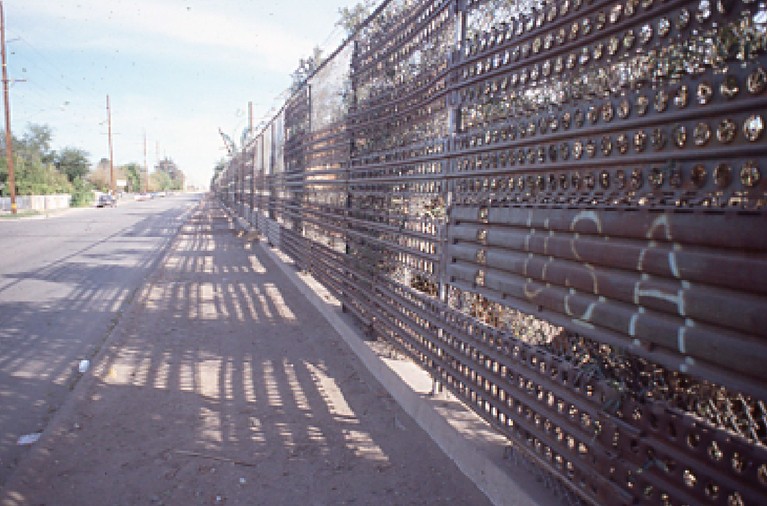
On a dusty side street in the Mexican border town of Nogales, in the shadow of the steel and concrete fence
barring illegal immigrants from the United States, stands a brightly painted building with a tin roof. Bars
cover the windows of Mi Casa Nueva --Spanish for ,'my new house'-- and the doors are locked to adults. But
the building is open to any child that wants a hot meal, a change of clothes, or simply a respite from the
streets for a few hours. The safe house has been set up by volunteers on both sides of the border to provide a
sanctuary for the town's child vagrants [known as bajadores or "tunnel rats"] some young as six, who live in
old storm drains 20 feet below the ground amid the sewage and garbage that seeps downhill from Mexico into
Arizona. Abandoned, abused, doing whatever it takes to stay alive, the children have made these sewers and
the streets around the sewage outlets their own. There are estimated to be at least 200 of them. Many are
braindamaged from the stolen additives, spray paint and other substances they use in a constant effort to stay
high and escape their wretched reality. Disease and violence are a way of life --not long ago, one 15-year-old
was stabbed to death by a 13 year-old in a fight over a girl. The Economist, February 1st 1997.
Charlas (bajadores)
"En una calle lateral del pueblo fronterizo de Nogales, en la sombra de la cerca de concreto y acero que
obstaculiza a inmigrantes ilegales la entrada a Estados Unidos, se encuentra un edificio vivamente pintado con
un techo de hojalata. Las ventanas están cubiertas con barrotes en Mi Casa Nueva, y las puertas están cerradas
para adultos. Pero el edificio está abierto para cualquier niño que quiera una comida, un cambio de ropa o
simplemente un descanso de las calles por unas cuantas horas. Esta casa franca ha sido preparada por
voluntarios en ambos lados de la frontera para servir de refugio para los niños vagabundos, [conocidos como
bajadores o "ratas de tunel"] algunos de ellos son pequeños de seis años, y viven en las viejas alcantarillas 20
pies bajo tierra entre el drenaje y la basura que se filtran cuesta abajo de México a Arizona. Abandonados,
maltratados, haciendo lo necesario para sobrevivir, los niños se han apropiado de estas alcantarillas y de las
calles donde hay rejillas. Se calcula que hay por lo menos 200 de estos niños. Muchos sufren de daños
cerebrales por los aditivos, pinturas en aerosol y otras sustancias robadas que usan en un esfuerzo constante
por permanecer drogados y escapar su miserable realidad. La enfermedad y la violencia son el medio de vida --
hace poco, un chico de 15 años mató a uno de 13 años a cuchilladas en un pleito sobre una niña." The
Economist, primero de febrero de 1997.
Dichos (Tiempo) Camina como chencha: 2 pasos para adelante y 3 pasos para atrás Walks like a chencha:
2 steps forward, 3 steps back
Q
CharIas (Ident/Enforce/Inspass)
"A 2.2 billion project to automate many of the Immigration and Naturalization Services most important tasks,
including airport inspections and tracking illegal immigrants, is in trouble, the Justice Department's inspector
general said today. The project has been so poorly managed that it has no internal benchmarks that would
allow managers and independent auditors to judge whether it was on schedule or within costs limits, or to
otherwise quantify its progress, the inspector general, Michael R. Bromwich, said. Mr. Bromwich singled out
three of the agency's larger technology programs for criticism, including Ident, an automated fingerprint
identification system used to track illegal immigrants. The system has been installed at 80 stations along the
Southwest border and is working well at individual stations. But Mr. Bromwich said there was no network to
allow all the stations to communicate. Another program, Enforce, is designed to replace 50 paper forms used
to process illegal immigrants with an automated system. Mr. Bromwich said the system, now in prototype, is
two years behind schedule. A third program, Inspass, allows low-risk, foreign frequent travelers to speed
through immigration inspections at high-volume airports and border crossings. Mr. Bromwich said the cost of
the program may outweigh its benefits, and that the system, used at Newark International and John F.
Kennedy International Airports, as well as a Toronto airport, is also behind schedule. Not all of the agency's
technology is foundering. Mr. Bromwich praised two of the agency's programs: new motion sensors that detect
illegal U.S.-Mexico border crossings, and an automated system that tracks refugees. The New York Times,
"Immigration Service Faulted On Oversight of Automation" Eric Schmitt, Febrary 27, 1997.
Charlas (Ident/Enforce/Inspass)
"Un proyecto de 2.2 billones para automatizar muchas de las labores más importantes del Servicio de
Inmigración y Naturalización, incluyendo las inspecciones de aeropuerto y encontrando a inmigrantes ilegales,
tiene problemas, dijo hoy el inspector general del Departamento de Justicia. El proyecto ha sido manejado tan
mal que no se tienen puntos de referencia internos que les permita a los administradores y a los auditores
independientes juzgar si el proyecto se está llevando a cabo oportunamente o dentro de los límites del
presupuesto, o de alguna manera cuantificar su progreso, dijo el inspector general, Michael R. Bromwich. El Sr.
Bromwich criticó a tres de los programas más importantes de la agencia, incluyendo Ident, un sistema
automatizado para identificación de huellas digitales utilizado para encontrar a inmigrantes ilegales. El sistema
ha sido instalado en 80 estaciones a lo largo de la frontera sudoeste y está funcionando bien en estaciones
individuales. Pero dice el Sr. Bromwich que no hay una red que permita que se comuniquen las estaciones.
Otro programa, Enforce, está diseñado para remplazar 50 formularios de papel utilizados para procesar a
inmigrantes ilegales con un sistema automatizado. El Sr. Bromwich dijo que el sistema, actualmente en
prototipo, tiene dos años de retraso. Un tercer programa, Inspass, permite agilizar la inspección de viajeros
extranjeros de bajo riesgo y que viajan frecuentemente, en aeropuertos y garitas fronterizas de alto volumen.
El Sr. Bromwich dijo que el costo del programa puede ser mayor que los beneficios, y que el sistema, utilizado
en los aeropuertos internacionales de Newark, John F. Kennedy y Toronto, también se ha retrasado. No toda la
tecnología de la agencia está tambaleante. El Sr. Bromwich elogió dos de los prograrnas de la agencia: los
nuevos sensores de movimiento que detectan cruces ilegales en la frontera de México E.U., y un sistema
automatizado que rastrea refugiados." The New York Times, "Servicio de Inmigración Culpado por Descuido de
Automatización" Eric Schmitt, 27 de febrero de 1997.
Dichos (Memoria) El que es mentiroso tiene que tener mucha memoria A liar must have a very good
memory
R
Charlas (Mentira)
"If it's anyone's job, then it's the job of the rulers of our community: they can lie for the good of the
community, when either an external or an internal threat makes it necessary. No one else, however, should
have anything to do with lying. If an ordinary person lies to these rulers of ours, we'll count that as an
equivalent in misguidedness, if not worse, to a patient lying to his doctor about his physical condition, or an
athlete in training lying to his trainer about his physical condition, or someone misleading a ship's captain,
with respect to his ship or crew, by telling him lies about his own state or that of one of his fellow crewmen"
Plato - Republic, Translated by Robin Waterfield, Oxford University Press, 1993.
Charlas (Mentira)
"Si es que a alguien le corresponde, entonces le corresponde a los gobernantes de nuestra comunidad: pueden
mentir por el bien de la comunidad, cuando una amenaza interna o externa lo haga necesario. Nadie más, sin
embargo, debe mentir. Si una persona ordinaria le miente a nuestros gobernantes, esta insensatez la
contaremos como el equivalente o peor, de un paciente mintiéndole a su médico sobre su condición física, o un
atleta en entrenamiento mintiéndole a su entrenador sobre su condición física, o alguien engañando al capitán
de un barco con respecto a su nave o su tripulación, al decirle mentiras sobre su propio estado o el de uno de
sus compañeros" Platón - La República, Traducido por Robin Waterfield, Oxford University Press, 1993.
RR
Oración a la Anima Sola de
J U A N S O L D A D O
Alabado sea el Santísimo Nombre del Padre, el Hijo y el Espíritu Santo; tres divinas personas y
un solo Dios verdadero. Quienes con su infinito y Misericordioso Poder, han colmado de gracia y
milagrosas indulgencias a mi querido hermano y protector Juan Castillo Morales.
En el nombre de Dios Todopoderoso, Espíritu y Anima de Juan Soldado, por motivos muy ciertos
y con mi corazón rebozante de Fé en tu inmediata ayuda, vengo a confiarte todas mis penas que me
atormentan moral y materialmente, no dudando ni un instante que por medio de tu Infalible
Intercesión ante el Todopoderoso vea colmados mis buenos deseos, si éstos convienen a mayor Gloria de
Dios Nuestro Señor y Tuya en Particular.
SE HACE LA PETICION DESEADA
Como te darás cuenta JUANITO, mis anhelos están desprovistos de capciosas maldades y todo lo que
deseo es encontrar un apoyo eficaz de tu parte para acallar la indigencia moral y material en que me
encuentro sumido.
HERMANO JUAN SOLDADO: Yo te suplico encarecidamente que no me abandones con tu
protección en esta difícil prueba.
Confío en la Omnipotencia Misericordiosa de dios y en tu Infalible Ayuda, prometiéndote desde
este momento, ser uno más de tus innumerables devotos. AMEN.
Como final se rezan tres Padres Nuestros.
NOTA: Ofrézcase la presente oración en culaquier momento, pero de preferencia a las 12:00 y 15:00
horas.
Dichos (Braceros en Aztlán: 1940's) se pueden matar 2 pájaros de un tiro killing two birds with one stone
S
Charlas (Politics)
"Is it a new day for state politics? What with the first Latino speaker of the Assembly in California's history,
the enactment of a promising campaign finance reform initiative and two-term Governor Pete Wilson a fast
diminishing figure in our collective rear-view mirror, the argument for the new day scenario is clear. The
Legislature is looking more like California, a cleaner political system --and term limits may well continue the
process. A cynically small-minded period in the executive governance of the state is ending even sooner than
anticipated. All very much to the good." San Francisco Chronicle, "The Election's Impact on California" Sam
Bradley, January 1997.
Charlas (Politica)
"¿Es un nuevo día para la política del estado? Entre el primer latino como presidente de la Asamblea en la
historia de California, la promulgación de una iniciativa para reformar el financiamiento de campañas y el
Gobernador de dos periodos Pete Wilson siendo una figura que se aleja en nuestros retrovisores colectivos, el
argumento es claro para el panorama de un nuevo día. La Legislatura se parece más a California, un sistema
político más limpio -- y los límites de mandato muy bien pueden continuer el proceso. Un periodo cínicamente
cerrado de mente en el gobiemo ejecutivo del estado, termina antes de lo anticipado. Y para bien." San
Francisco Chronicle, "El Impacto de la Elección en California" Sam Bradley, enero de 1997.
Dichos (Dinero) En casa de herrero cucharas de palo In the plumber's house, leaking faucets
T
Charlas ($)
"As Federal agencies issued a torrent of cheery reports in the last few weeks about rising incomes, falling
poverty rates and improvements in educational performance, one group buckled the trends: Hispanic people.
For the first time, in fact, a higher proportion of Hispanic people than of blacks were officially defined as poor
--a consequence, in part, of dramatic increases in the income of black households, but also of declining
incomes among Hispanic households. Income figures help explain the demonstration. Recently, the Census
Bureau reported that for the first time in six years, median household income rose for the country over all,
increasing by 2.7 per cent in 1995. The 3.6 per cent increase in median black income was particularly
dramatic. Meanwhile, though, median household income among Hispanics fell by 5.1 per cent. For now,
Hispanic people are stuck at the low end of the labor force and and are subject to the chilling trends that
buffet all low income workers in this country --globalization of the economy, the loss of manufacturing jobs,
poor performances of schools in low income areas and, yes, immigration. "It's really easy to divert attention
away from the issue of poverty because it's a hard issue, it's a complex issue," said Sonia Perez, director of the
poverty project at the National Council of La Raza. "It's alot easier to say, it's immigrants and it will go away
in two or three generations. It's alot harder to say it has to do with low wages and low education and high
unemployment and how do you create jobs. Those things have policy responses. But they're hard and they're
harder to talk about, especially in this climate." The New York Times, "For Hispanic Poor, No Silver Lining"
Steven A. Holmes, Sunday, October 13, 1996.
Charlas ($)
"Mientras que agencias federales expidieron un torrente de alegres reportes en las últimas semanas sobre el
incremento de ingresos, niveles de pobreza descendiendo y mejoras en la educación, un grupo dislocó la
tónica: los hispanos. Por primera vez, de hecho, una proporción más alta de gente hispana que de negra fue
oficialmente definida como pobre - una consecuencia, en parte, del dramático incremento de ingresos en los
hogares negros, pero también en los ingresos menguantes en los hogares latinos. Estadísticas de ingresos
pueden ayudar a explicar la demostración. Recientemente, el Censo reportó que por primera vez en seis años,
el ingreso medio por hogar subió en todo el país, incrementando por 2.7 por ciento en 1995. El incremento del
3.6 por ciento en el ingreso medio negro fue particularmente dramático. Mientras tanto, el ingreso medio
entre hispanos bajó por 5.1 por ciento. Por ahora, los hispanos están atrapados en el extremo bajo de la fuerza
laboral y están sujetos a las escalofriantes tendencias que sacuden a todos los trabajadores de bajos ingresos en
este país -- globalización de la economía, la pérdida de empleos de manufactura, mal desempeño en las escuelas
en áreas de bajos ingresos y, sí, inmigración. "Es muy fácil desviar la atención del tema de la pobreza porque
es un tema difícil, es un tema complejo", dijo Sonia Pérez, directora del proyecto de la pobreza en el Consejo
Nacional de la Raza. "Es mucho más fácil decir que son los inmigrantes y que desaparecerá en dos o tres
generaciones. Es mucho más difícil decir que tiene que ver con sueldos bajos y baja educación y desempleo
alto y ¿cómo crear empleos? Esas cosas tienen respuestas políticas. Pero son difíciles y es más difícil hablar de
ellas, especialmente en este clima". The New York Times, "Para los Hispanos Pobres, No Hay Píldora Dorada"
Steven A. Holmes, domingo 13 de octubre de 1996.
Dichos (Political Economy of the Sign) Perro que ladra no muerde Dogs that bark don't bite
U
Charlas (Citizenship/Voting Rights)
"Article IX provided that those who did not choose to remain Mexican citizens would be considered 'to have
elected' to become U.S. citizens. As early as 1849 the nature of citizenship rights of these Mexicans became
the subject of controversy. In California the delegates to the state constitutional convention wrestled with the
problems of race, rights of citizenship, and the Treaty of Guadalupe Hidalgo. Six of the delgates were native
Califomios (former Mexican citizens) who were aware that Mexicans who looked like Inidians faced the prospect
of racial discrimination. Ultimately they argued for the protection of their class even if it meant endorsing the
racist views of their Anglo colleagues towards Indians and Blacks. Mexico had granted citizenship to 'civilized'
Indians and to Blacks, and the Treaty of Guadalupe Hidalgo clearly stated that former Mexican Citizens would
be given the opportunity to become citizens of the United States. Following the biases of their age, the
framers of the state constitution sought wording that would exclude Blacks and Indians while including
Mexicans. A Mr. Edward Gilbert introduced a proposal that eventually became the first section of the state
constitution defining suffrage. It extended the vote to 'every white, male citizen of Mexico who shall have
elected to become a citizen of the United States.' The convention agreed that Indians and Blacks might at
some future date be given the franchise but that because voting was not an absolute right of citizenship, they
could be excluded. There was some concern over whether in fact the Mexicans remaining were citizens of the
United States. Ultimately the delegates agreed 'it would seem that they are not in fact American citizens, but
require some further action of Congress to make them citizens of the united States.' Califomia's admission as a
state presumably would be that conferring act. (Later court cases challenged this assumption.) The ambiguous
citizenship of the califomios meant that they could not expect the full protection of the laws during a stressful
and violent period in Califomia's history." The Treaty of Guadalulpe Hidalgo: A Legacy of Conflict, Richard
Griswold Castillo, University of Oklahoma Press, 1990.
Charlas (Ciudadanía/Derechos de Voto)
"El Artículo IX estipuló que para aquellos que no eligieron permanecer como ciudadanos mexicanos se
consideraría que habían 'elegido' convertirse en ciudadanos estadounidenses. En 1849 la naturaleza de los
derechos de estos mexicanos se convirtió en tema controvertido. En California los delegados de la convención
constitucional del estado lidiaron con los problemas de raza, derechos de ciudadanía y el Tratado de Guadalupe
Hidalgo. Seis de los delegados eran californios oriundos (anteriormente ciudadanos mexicanos) que estaban
conscientes de que los mexicanos que parecían indios se enfrentaban a la perspectiva de la discriminación
racial. Ultimadamente pelearon por la protección de su clase, aún cuando significó aprobar las ideas racistas de
sus colegas anglos hácia los indios y los negros. México les había otorgado ciudadanía a los indios y a los
negros'civilizados', y el Tratado de Guadalupe Hidalgo claramente declaró que a los anteriores ciudadanos
mexicanos se les daría la oportunidad de convertirse en ciudadanos de Estados Unidos. Siguiendo los prejuicios
de su era, los creadores de la constitución estatal buscaron términos que excluían a los negros y a los indios
mientras incluían a los mexicanos. Edward Gilbert introdujo una propuesta que a la larga se convirtió en la
primera sección de la constitución estatal que definía el sufragio. Le extendía el voto a todo hombre blanco
ciudadano de México que hubiera elegido convertirse en ciudadano de Estados Unidos. La convención acordó
que en un futuro se les podría otorgar el sufragio a los indios y los negros, pero como el voto no era un
derecho absoluto de la ciudadanía, podrían ser excluidos. Había cierta preocupación sobre el hecho de que si
los mexicanos restantes eran ciudadanos de Estados Unidos. En última instancia, los delegados acordaron que
'parecería ser que de hecho no son ciudadanos de Estados Unidos, que el Congreso tendría que tomar alguna
otra acción para hacerlos ciudadanos de Estados Unidos'. El ingreso de California como estado supuestarnente
concedería esta acción. (Más tarde los tribunales retaron esta suposición.) La ambigua ciudadanía de los
californios significó que no podían esperar la completa protección de las leyes durante este angustiante y
violento periodo en la historia de California". The Treaty of Guadalupe Hidalgo: A Legacy of Conflict, Richard
Griswold Castillo, University of Oklahoma Press, 1990.
Dichos (Y2K: y tú ¿que?) El que con niños se acuesta, miado despierta S/he who plays with fire
V
Charlas (soy single bilingual)
"In the next year or so whites will become a minority of the Californian population. A state that was 90%
white in 1900 will have evolved --or perhaps disolved-- into a polyethnic society, with a cacophony of more
than 160 languages in Los Angeles schools. The transformation of minorities into a majority will, if present
trends persist, slowly be repeated across the rest of the country: in Texas by about 2015, followed by Arizona,
New York, Nevada, New Jersey and Maryland. By the middle of the next century the United States will be
almost half non-white. California is thus playing two central roles in the remaking of America: as a port of
entry for immigrants and as the pioneer of a new type of polyethnic society." "Polyethnic America: The sun
rises in the west" review of "The Coming of the White Minority: Califomia's Eruptions and the Nation's Future"
by Dale Maharidge, Times Books, in The Economist, February 15, 1997.
Charlas (soy single bilingual)
"En el próximo año los blancos se convertirán en una minoría en la población de California. Un estado que
tenía un 90 por ciento de blancos en 1900 habrá evolucionado -- o quizá se habrá disuelto -- en una sociedad
poliétnica, con una cacofonía de más de 160 idiomas en las escuelas de Los Angeles. La transformación de
minorías a una mayoría, se repetirá lentamente, si persiste la actual tendencia, a través del resto del país: en
Texas para el año 2016, seguido por Arizona, Nueva York, Nevada, Nueva Jersey y Maryland. Para mediados del
próximo siglo, casi la mitad de Estados Unidos no será blanca. Por lo tanto, California está desempeñando dos
papeles centrales en la nueva versión de Estados Unidos: como puerto de entrada para inmigrantes y como
pionero en un nuevo tipo de sociedad poliétnica". "Estados Unidos Poliétnico: el sol sale por el oeste." Reseña
de "The Coming of the White Minority: California's Eruptions and the Nation's Future" por Dale Maharidge,
Times Books, en The Economist, 15 de febrero de 1907.
Dichos (Deseos) Cataplasmas del olvido con fomentos de otro amor Cataclysmic oblivion with signs of
another love
W
Charlas (21 Century Polyethnic America)
"Among American-born married women ages 20 to 29 in 1990, 67 percent of Asian-Americans and 38 percent
of Hispanic women married outside their ethnic group, according to Zhenchao Qian of Arizona State University.
Only 3 percent of African-American women currently marry outside their race, a testament to their extreme
residential and social isolation." The New York Times Magazine, "Children Will Pay: Demography's crystal ball
shows that 21st-century America will be older, wiser and more ethnically diverse. But its kids face trouble."
Samuel H. Preston. September 29, 1996.
Charlas (Estados Unidos Poliétnico del Siglo 21)
"En 1990, de las mujeres nacidas en Estados Unidos entre las edades de 20 a 29 años, el 67 por ciento de las
mujeres asiáticas y el 38 por ciento de las mujeres hispanas se casaron fuera de su grupo étnico, de acuerdo a
Zhenchao Quian de la Arizona State University. Sólo el 3 por ciento de las mujeres negras actualmente se
casan fuera de su raza, un testamento a su extrema aislación residencial y social." The New York Times
Magazine, "Los Hijos Pagarán: La bola de cristal demográfica muestra que los Estados Unidos del siglo 21 serán
más ancianos, más sabios y étnicamente más diversos. Pero sus jóvenes tendrán problemas." Samuel H.
Preston. 29 de septiembre de 1996.
Dichos (Define the Enemy) De tal palo, tal astilla The apple falls not far from the tree
X
Charlas (Education)
'African American and Latino high school students are leaving San Francisco public schools faster than other
groups, reflecting trends that educators say are undermining the education of disadvantaged and vulnerable
teens in urban areas. The number of African Americans in San Francisco's Unified graduating class of 1996
shrank 55 percent over four years, according to district figures. Latino enrollment in the class of 1996 fell 44
percent since 1992. Educators and children's advocates say the decline reflects family instability, a shortage of
affordable housing, a lack of high-paying jobs, and the need for more school counselors. 'It's kind of an
evolutionary thing where where it begins early in the educational experience,' she said. 'Students feel as
though they are not important. They don't see the value of remaining in school to a higher good. There are
too many of them and they come back to us in terrible ways, coming as prison statistics." San Francisco
Examiner, "Educators lay blame for S.F. dropouts - Blacks, Latinos quit at higher rate" Venise Wagner, June 17,
1996.
Charlas (Educación)
Estudiantes de High School afroamericanos y latinos están abandonando las escuelas públicas de San Francisco
con mayor rapidez que otros grupos, reflejando las tendencias que los educadores dicen están debilitando la
educación de adolescentes desfavorecidos y vulnerables en áreas urbanas. El número de afroamericanos en San
Francisco que se graduaron en 1996 se encogió un 55 por ciento a lo largo de cuatro años, según los cálculos
del distrito. La inscripción de latinos en la clase a graduarse en 1996 cayó un 44 por ciento a partir de 1992.
Educadores y defensores infantiles dicen que este declive refleja la inestabilidad familiar, escasas viviendas
asequibles, falta de empleos bien pagados y la necesidad de más consejeros en las escuelas. 'Es como una cosa
evolutiva que comienza al principio de la experiencia educativa,' dijo. 'Los estudiantes sienten que no son
importantes. No ven la importancia de permanecer en la escuela para salir adelante. Hay demasiados que nos
llegan en forma de estadísticas de prisiones." San Francisco Examiner, "Educadores señalan culpables de que
alumnos en S.F. que no terminan sus estudios - negros y latinos abandonan la escuela con mayor frecuencia"
Venise Wagner, 17 de junio de 1996.
Dichos (¿Y tú que?) Lana sube lana baja y el que es hombre no se raja The harder they come the harder
they fall
Y
Charlas (Y2K'ers)
" . . . increasingly, the border is being fortified with yet another line of defense that even the fastest sprinter
may have trouble eluding. Whether using stealth or crossing legally by car, citizens and noncitizens alike
must now overcome a barrier of computer chips, copper wires, video monitors and camera lenses." The New
York Times, "A Silicon Wall Rises on the Border: Scanners, X-Rays and Databases Transform the Hunt for
Smugglers and Illegal Immigrants," by Verne G. Kopytoff, Thursday January 14, 1999.
Charlas (Y2K'ers)
" . . . cada vez más, va fortificándose la frontera con defensas imposibles de eludir, hasta por el más rápido
embalaje. Utilizando 'stealth' o cruzando legalmente por auto, todo ciudadano y hasta el que no lo es, tendrá
que pasar una barrera de discos de computación, alambre de cobre, pantallas de video, y lentes de cámara." The
New York Times, "A Silicon Wall Rises on the Border: Scanners, X-Rays and Databases Transform the Hunt for
Smugglers and Illegal Immigrants," por Verne G. Kopytoff, jueves 14 de enero, 1999.
Dichos (Sensuality) El coraz6n no se muere, el cuero es el que se arruga The heart never dies, only the
skin grows wrinkled
Z
Charlas (Eros + Aggression)
"Mexico City -- A new immigrant-based social movement has emerged on both sides of the U.S.-Mexico border
to seek redress from both governments. The roots of the grievance stretch back more than 50 years, to 1942,
when the U.S. government began the "bracero" program to fill labor shortages caused by World War II. Under
this program, the government issued contracts to Mexicans willing to cross the border for temporary
employment . . . braceros, working on farms and railroads, made it possible for the U.S. economy to meet the
challenges imposed by the war effort. Government and employers found the program so appealing that it was
extended, through various acts, until 1965. Then it was terminated unilaterally, after much pressure from
unions and activists concerned with the systematic exploitation of the workers. During its existence, some
44½ million contracts were issued. As part of their contract, braceros agreed to have 10 percent of their wages
placed in a fund controlled by the Mexican government. When they returned to Mexico, individuals could
request that the money be returned to them . . . {however} the overwhelming majority of workers never
received compensation. Moreover, the whereabouts of the funds remains unknown. Despite their contributions
to the U.S. and Mexican economies, many former braceros now live in poverty, abandoned by both
governments and without even the means to claim Social Security, which was supposed to be a benefit of the
program." San Francisco Examiner, "Braceros: Exploited, swindled, ignored" by Jesus Martinez, August 8, 1999.
Charlas (Eros + Agresión)
"México, D.F. -- Un nuevo movimiento social del inmigrante ha surgido en ambos lados de la frontera entre
méxico y los estados unidos, buscando remedios de ambos gobiernos. El motivo de queja regresa más de 50
años, al 1942, cuando el gobierno norte americano empezó el programa del 'bracero' para reemplazar la falta de
trabajadores causada por la segunda guerra mundial. Bajo este programa, el gobierno otorgó contratos a
mexicanos dispuestos cruzar la frontera para tomar trabajos interinos . . . braceros, trabajando de campesinos o
de ferrocarrilereros, ayudaron confrontar el reto impuesto a la economía norte americana por el esfuerzo contra
la guerra. El gobierno y los patronos encontraron el programa tan affectivo que fué prolongado, a través varios
actos, hasta el año 1965. Luego fué terminado unilateralmente, después de recibir muchísima presión de las
uniones y de activistas que contrarrestaban la explotación sistemática del obrero. Durante su existencia,
algunos 44½ millones de contratos fueron expedidos. Como parte del contrato, el bracero estubo de acuerdo
poner el 10 por ciento de su sueldo dentro un fondo controlado por el gobierno mexicano. Al regresar a
méxico, el indivíduo podría pedir el regreso de su dinero . . . {sin embargo} la mayoría de los trabajadores
jamás fueron compensados. Por otra parte, el paradero de los fondos permanece desconocido. A pesar de haber
sido contribuyentes a las economías de los estados unidos y de méxico, muchos braceros viven en la pobreza,
abandonados por ambos gobiernos y sin medios de poder reclamar Seguro Social, que debía ser un beneficio del
programa del bracero." San Francisco Examiner, "Braceros: Exploited, swindled, ignored" by Jesus Martinez,
August 8, 1999
[HTML Recovery END]
Recovery of Capilla Juan Soldado in progress January 18, 2026